
The Dispute Report: How Likely Is a Youth Sports Business to Win a Payment Dispute — and Why Baseline Facilities Win Nearly 9 in 10
Industry-wide, businesses answer barely half of their chargebacks and recover about 1 in 10. Across Baseline's platform of 1,100+ youth-sports businesses, 88% of closed disputes were won over the last three months — with 90% of responses filed without anyone touching a thing. How disputes actually work, what gets disputed at sports facilities (and which purchases win), why fraud codes are hardest, what each card network wants, and the pre-documented evidence system behind the numbers.
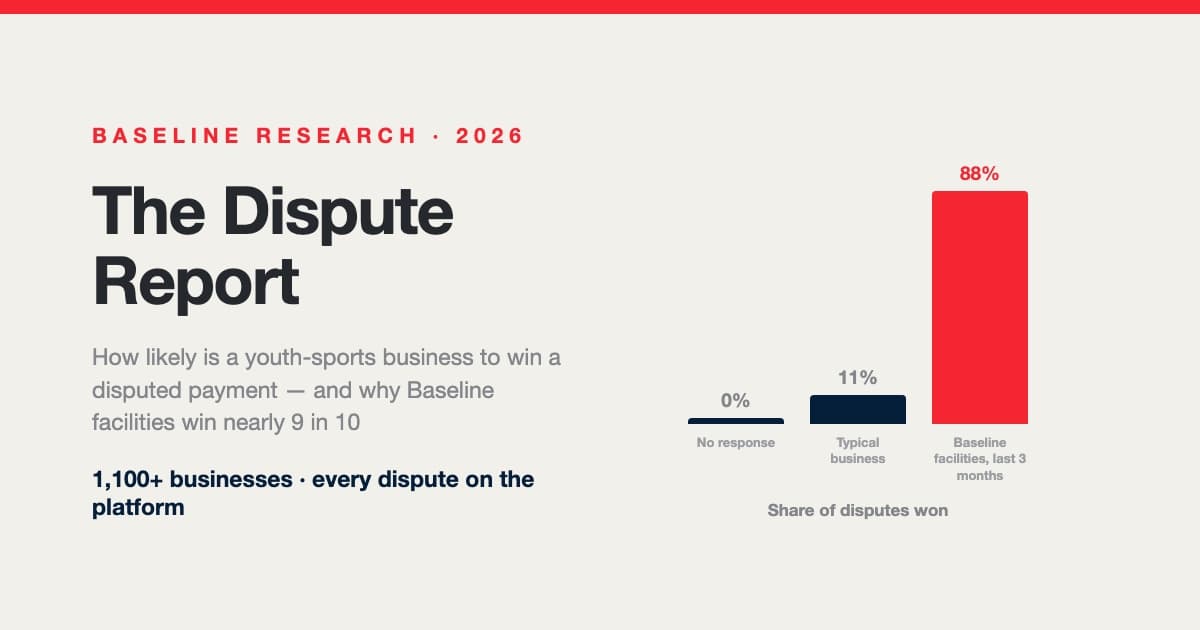
How likely is a youth-sports business to win a disputed payment? Industry-wide, the answer is bleak: merchants contest only about half of their chargebacks and win a fraction of those, recovering roughly 1 in 10 (Mastercard’s 2025 State of Chargebacks). Across Baseline’s platform of 1,113 youth-sports businesses, the same question has a different answer: 88.5% of closed disputes won over the last three months, with a response filed on every single one — 90% of them without anyone lifting a finger. The difference isn’t luck. Chargebacks quietly tax margins that youth-sports operators don’t have, so Baseline’s payment stack is built around one question: if this charge is ever disputed, how will we defend it? This report is the answer — the results, and a plain-English field guide to how disputes really work.
About this report — and what's in it
The headline numbers
- The gap is enormous. The typical merchant answers about 54% of chargebacks, wins ~20% of the ones they fight, and recovers roughly 11% of all disputes (Mastercard 2025). Facilities on Baseline answer 100% and win 78.7% of closed disputes over the study window — 88.5% in the last three months.
- Nine in ten responses involve no human at all. 90% of dispute responses went out exactly as the system wrote them — statements, policy citations, evidence files — and across the study window those all-automatic responses won 78.8% of closed disputes by themselves.
- Disputes are rare — and expensive to fight by hand. Disputes touch about 1 in 850 card payments (0.12% over the trailing year), the median disputed charge is $107, and the median business that has ever seen one has seen just one or two. But a manual response takes 2–5 hours of evidence-gathering against a days-long deadline — which is exactly why most businesses never file one.
- Fraud disputes are a different animal. When the claim is “I didn’t make this charge,” card-not-present rules stack the deck: merchants industry-wide win only ~9% of true-fraud disputes. Facilities on Baseline win 26.2% of them — via IP and device evidence — versus 95.1% on ordinary service disputes.
- Disputes arrive too late to start collecting evidence. The median dispute lands 27 days after the charge — 48% arrive more than a month later — while the practical response window is about 9 days. The agreement, the policy text, the checkbox, the IP address: they either exist from the moment of checkout or they never will.
- Elsewhere, this automation is a product you pay dearly for. Stripe’s equivalent auto-responder keeps 30% of the disputed amount on every dispute it wins — getting your own $107 back costs you $32. On Baseline, dispute defense is simply part of the payment stack: no success fee, no per-dispute fee, no add-on.
Part 1: The scoreboard — why almost everyone loses, and what changes when every dispute is answered
Start with the industry’s own numbers. Mastercard’s 2025 State of Chargebacks research (summarized by Chargeback Gurus) counts 261 million chargebacks globally in 2025, heading to 324 million by 2028 — and merchants simply eat 46% of them without a fight. Of the disputes they do contest, issuers rule for the merchant about 20% of the time (merchants self-report closer to 44% — Chargebacks911 2026). Multiply it out and the typical business recovers about 1 dispute in 10. Here’s that ladder, with Baseline’s rungs on it:
Two things make the industry number so low, and neither is a mystery. First, most disputes are never answered at all — and an unanswered dispute is an automatic loss; processors state this flatly. Second, answering is genuinely painful when you start from nothing: pulling transaction records, receipts, agreements, and communication threads takes 2–3 hours to 2–5 hours per case by industry estimates, or about $82 of internal labor per chargeback (Javelin Strategy & Research). In a Riskified survey of 300+ chargeback managers, 55% said their dispute process is too time-consuming, complex, and manual — and those are people whose job is disputes. For a facility owner coaching lessons at 6pm, the rational move has always been to eat the loss. We’ve heard it from operators directly: they didn’t respond because gathering the paperwork wasn’t worth the evening it would cost.
On Baseline the funnel doesn’t leak, because responding isn’t work:
- Every dispute gets answered. The system drafts the full response the moment a dispute arrives and files it automatically before the deadline if nobody intervenes. Across the study window, not one dispute expired unanswered — the response rate is 100%, against the industry’s ~54%.
- 90% of responses were filed with zero human editing — the statements, policy citations, and evidence packages went out exactly as generated — and won 78.8% of closed disputes on their own across the study window. When facilities did step in and add context, it was on the messiest cases — a member trying to backdate a cancellation, a customer who turned hostile — and even those won at essentially the same rate. The automation floor is that high.
- The money comes back. $41,617 in disputed charges returned to facilities in 2026 so far — $22,001 of it in the last three months. At the industry’s ~11% net recovery, most of that would simply be gone.
- Staying under the radar matters too. Card networks monitor dispute ratios, and merchants who cross the thresholds (Visa’s consolidated VAMP program tightens to 1.5% of transactions in April 2026; Mastercard’s excessive program starts at 1.5% plus 100 monthly chargebacks) face fines and, eventually, the loss of card processing. Baseline’s stack runs at 0.12% — less than a tenth of the danger zone.
The time nobody has — returned
Part 2: How a chargeback actually works
Now the field guide. A chargeback starts at the cardholder’s bank, not yours. The customer calls the number on their card, says some version of “I don’t recognize this / I canceled this / this isn’t what I paid for,” and the bank — the issuer — files a dispute through the card network. Three things happen immediately, and none of them involve asking your side of the story first:
- The money is pulled from your account on day one. The full disputed amount is debited and held while the dispute runs. You’re fighting to get your own money back.
- A deadline starts ticking. Card networks nominally give merchants 20–45 days to respond, but the payments stack in between compresses that window so evidence can be packaged and forwarded upstream (Adyen publishes windows as short as 9 days for Visa; Stripe tells merchants 7–21 days). In our data the practical window is about 9 days, median. Miss it and you lose automatically — there is no appeal for a missed deadline.
- A bank analyst decides on paper. No hearing, no phone call, usually one shot. Issuers review thousands of responses a day, and processor guidance is blunt about what works: short, factual, and backed by attachments — Stripe’s best-practices page warns that issuers won’t comb through long files (Mastercard literally caps evidence at 19 pages). In our data, disputes that were ultimately won were decided within a median of 12 days of the dispute being opened.
This structure also explains something every business owner has grumbled about: the paperwork gauntlet payment platforms put you through before you can accept a single card. Processors like Stripe and JustiFi demand identity documents, business details, and bank verification — KYC and underwriting — because card processing is structurally a loan. A cardholder can dispute a charge up to 120 days after it posts (up to 540 days in some cases), so every dollar a processor settles to you is a dollar a bank might claw back months later. If the business can’t cover it, the processor eats the loss — so they underwrite you like a lender sizing credit risk. Your processing history, and your dispute record, is effectively your credit score with them.
The part almost nobody internalizes is the timeline mismatch that dispute window creates. In our data the median dispute arrives 27 days after the charge, and 48% arrive more than a month later:
By the time the dispute exists, the checkout page the customer saw, the policy that was in force, and the box they checked are a month in the past. If those weren’t captured at the moment of purchase, they cannot be reconstructed — and the response becomes your word against the cardholder’s. That single fact is why Baseline’s system works the way it does (Part 5).
Part 3: What actually gets disputed at a sports facility
Disputes at sports facilities are a low-frequency, high-stakes event: they touch roughly 1 in 850 card payments, the median disputed charge is $107 (quartiles $79–$315), and the median business that has ever seen a dispute has seen just one or two — ever (61% have seen no more than two). When one lands, it lands on whoever runs the front desk.
That mix is no accident. Recurring billing is where customers get surprised: industry-wide, subscription businesses run dispute rates around 1–2% versus 0.5–0.7% for one-time e-commerce (Presolve), and the card networks consider surprise-billing enough of a problem that they wrote rules about it — Visa has required advance reminders with a cancellation link for trial-to-subscription conversions since 2020 (Chargeback Gurus), and Mastercard’s 2022 subscription standards require receipts after every billing and an online cancellation mechanism (Checkout.com).
Here’s the twist, though: the products that get disputed most are also the ones Baseline defends best — because recurring products carry the deepest paper trail. A membership dispute meets an enrollment record with an auto-renewal consent checkbox, an emailed terms document, advance charge reminders, and a self-serve cancel button the customer never clicked:
Every dispute also carries a network reason code, which collapses into four claims. They are not equally winnable:
Which payment gets disputed? Not the one you’d guess
The intuition is that disputes come from strangers — a sketchy first-time checkout, a card you’ve never seen. The data says the opposite. Placing each disputed charge inside that customer’s payment history with the business: only 9.3% of disputes are the customer’s first payment. The median disputed charge is the customer’s 6th payment, landing about 91 days into the relationship (among repeat customers), from a customer who had already paid the business a median $687 without complaint. Membership-cancellation disputes are the purest case: not one was a first payment — they’re renewals, by definition from established customers.
One pattern stands out as an early-warning flag: payments that struggled to collect show up among disputes with a much worse outcome profile. About 14% of disputed charges had failed at least one collection attempt before finally going through, and 25% of disputers had some failed-payment history with the business. The win-rate gap is stark: disputes on charges that collected on the first try win 86% (137 of 160 closed); disputes on charges that needed retries win just 34% (10 of 29). That’s not an argument against recovering failed payments — a recovered payment is real revenue, and most recovered payments are never disputed — it’s a signal about the customer: sometimes a charge that had to be chased marks a family that was already halfway out the door. The operational takeaway: when a payment has to be dragged in, treat it as a relationship flag, not just a collections win — a two-minute check-in with that family is cheaper than the dispute that may follow.
Part 4: Why fraud disputes are different — and the friendly-fraud problem
When the cardholder claims the charge itself was unauthorized — a stolen card number, an account takeover — the network rules largely pre-assign liability to the merchant for online (card-not-present) payments. You’re not arguing about service quality anymore; you’re arguing about identity, with the deck stacked. Industry-wide, merchants win roughly 44% of “friendly fraud” disputes but only ~9% when true criminal fraud is involved (2024 State of Chargebacks data via Curbstone). Our numbers agree: facilities on Baseline win 26.2% of fraud-coded disputes, versus 95.1% on service disputes and 88.9% on membership-cancellation claims.
The twist is that most “fraud” isn’t fraud. Visa’s own reporting attributes up to 75% of chargebacks to “friendly fraud” — a real cardholder disputing a real purchase, whether from confusion (an unrecognized statement descriptor, a spouse’s purchase, a kid’s registration) or as a de-facto refund request that skips the awkward phone call. Mastercard’s 2025 research says nearly half of chargebacks are friendly fraud, and 62% of merchants in the Merchant Risk Council’s 2026 global survey report it rising.
The networks’ answer is data. Visa’s Compelling Evidence 3.0 rules (April 2023) let a merchant flip liability on a card-not-present fraud dispute by showing two prior undisputed transactions from the same device or IP address 120–365 days back (Qualpay’s summary); Mastercard’s First-Party Trust program (2024) works the same way with purchase-history and device data (Mastercard). Translation: the IP address and device fingerprint captured at checkout are now the strongest fraud rebuttal that exists — but only if someone was saving them all along.
When card fraud hits, it clusters
Part 5: How it works — every payment is pre-documented for its own defense
The system’s design premise comes straight from Part 2: most disputes are won or lost months before they exist, because the deciding evidence can only be created at the moment of purchase. So Baseline treats every single payment as a future dispute case file. Not as paranoia — as architecture: the booking flow, the waiver system, the membership terms, and the receipt pipeline all capture their evidence as a side effect of normal checkout. The facility does nothing; the case file builds itself.
Job 1: Every checkout quietly builds a case file
| Evidence | Captured | What it defeats |
|---|---|---|
| Versioned policy text + required acceptance checkbox | Every checkout — payment can’t submit without it | “I never agreed to that policy” |
| Waiver signature record — frozen text snapshot, drawn signature, timestamp, IP, device | At signing, with an emailed acceptance certificate (delivery message-ID saved) | “That’s not my signature / I never saw those terms” |
| Membership terms document — price, billing dates, auto-renewal consent, cancellation deadline and method, state-aware terms | Generated and emailed on first membership payment | “I didn’t know it renewed” |
| Advance auto-charge reminder — exact amount and date, with update-payment and view-invoice buttons; send date stamped on the transaction | Days before every recurring charge | “I didn’t know I’d be charged” |
| Self-serve cancellation in the customer’s profile | Always available (and required by Mastercard’s subscription standards and several states) | “I tried to cancel” — no cancellation on file becomes evidence |
| Itemized receipt PDF | Emailed at every checkout, stored on the transaction | “I don’t recognize this charge” |
| Payment mandate with IP + device on stored-credential charges; purchase IP on the account | Login, registration, and checkout flows | Fraud claims — this is exactly the Compelling Evidence 3.0 data |
This is the part that kills the industry’s “it takes hours” problem at the root. The 2–5 hours merchants spend per dispute is almost entirely retrieval — hunting through the processor dashboard, the CRM, the email archive, the signed-waiver drawer. Baseline never has to retrieve anything, because nothing was ever scattered: every artifact is already attached to the transaction it defends.
Job 2: When the dispute arrives, the response writes itself
- Instant intake. A webhook creates the dispute record — amount, reason, due date, linked transaction — the moment the payment platform reports it. A daily sync double-checks the full list so nothing slips between systems.
- Purchase-aware pre-fill. Within seconds the handler classifies what was bought and drafts the full response for that shape: an event dispute cites the event date, the cancellation window shown at checkout, and the policy version; a membership dispute cites the renewal consent checkbox and the absence of any cancellation; a team-fee dispute frames the charge as an agreed installment and lists the prior installments paid without complaint. If a refund was already issued, the draft says so — with the amount and date — instead of fighting a settled charge.
- Evidence assembly. The handler generates and uploads the file evidence, mapped to the card networks’ evidence categories: a policy acceptance certificate (compiled from the versioned policy plus every waiver and contract tied to the purchase, wrapped in acceptance metadata — IP, device, timestamp), the original receipt, and the membership terms document. Everything submitted is archived to the account’s own evidence store.
- The admin gets a finished draft, not a to-do. Every admin is emailed immediately: who disputed, what, for how much — and that evidence is already assembled. The dispute panel shows the countdown, the checklist, and every pre-filled statement, all editable, with room to add context (photos, message threads, attendance logs). Adding context takes minutes — and remember from Part 1: 90% of the time, nobody needs to.
- The deadline net. A daily job finds any dispute still unanswered 48 hours before its due date and files the response automatically — statements, identity evidence (name, email, billing address, purchase IP), and every uploaded file. No dispute expires unanswered. Worst case is a complete, professional response built from everything on file; best case is that plus the admin’s local knowledge.
- Resolution tracked. Outcomes sync back automatically, so the dashboard always shows where every dispute stands — including the option to deliberately accept a chargeback (behind a typed confirmation) when refunding is simply right.
One design detail worth naming: the evidence research in Part 2 says concise wins. The handler’s output is deliberately short — a factual timeline, the specific policy language the customer accepted, and a handful of attachments in the network’s own categories. It reads like the responses issuers say they want, because that’s what it was built from.
What the same protection costs everywhere else
Automated dispute response exists elsewhere — as a product you pay for, sometimes startlingly so:
| Platform | What you get | What it costs |
|---|---|---|
| Stripe (Smart Disputes) | Auto-assembled evidence, auto-submitted before the deadline | 30% of the disputed amount on every win, on top of a $15 fee per dispute received |
| PayPal (protection tools) | Insurance-style coverage on eligible transactions | 0.40–0.60% of every transaction, disputed or not |
| Square (disputes team) | Human help filing — you still gather the evidence | No fee, hours of your time |
| Baseline | Pre-documented evidence, auto-assembled and auto-filed, admin review optional | $0 — included in Baseline Payments |
Read the Stripe line again: to recover money that was yours in the first place, the platform keeps nearly a third of it. Win back a typical $107 membership charge through Smart Disputes and about $32 of it stays with Stripe — for submitting evidence a computer assembled. (Stripe publishes no win rate for the product, only an average 18% lift in recovered volume.) Baseline runs the same play — automated evidence, automated filing, measured at 88.5% of closed disputes won over the last three months — for nothing, because dispute defense isn’t an upsell here. Winning your disputes is what the payment stack is for.
Part 6: The referee matters — how each network plays it
“The card company” isn’t one thing. Who decides your dispute — and how much room you have to fight — depends on the network the card runs on:
| Network | Who decides | Merchant evidence window | What tilts it |
|---|---|---|---|
| Visa | Issuer, inside Visa’s rules engine (VROL) | 30 days network-side; days at the processor layer | Fraud and authorization codes route through “allocation” — liability is assigned up front and you must qualify to overturn it. Compelling Evidence 3.0 (prior undisputed device/IP history) is the qualifying key. |
| Mastercard | Issuer, with a defined representment cycle | 45 days nominal — processors pass along far less | Cleanest escalation path (representment → pre-arbitration → arbitration). First-Party Trust (2024) rewards merchants who share purchase-history and device data. Subscription standards require receipts and online cancellation. |
| American Express | Amex — it is both network and issuer | ~20 days, the shortest of the majors | Closed loop: the referee owns the cardholder relationship, and there’s no independent arbitration. Amex’s “inquiry” stage is the real fight — answer it well and the chargeback may never be filed. |
| Discover | Discover — also closed loop | ~20 days | Opens with a “ticket retrieval” documentation request; responding fast and completely at that stage is most of the game. |
(Windows per Chargeflow, Chargebacks911, Chargeback Gurus, and Justt; processor-layer windows per Adyen.) The practical takeaway: the window you actually get is set by the payments stack, not the network — plan for days, not weeks — and the closed-loop networks reward speed and completeness even more than Visa and Mastercard do. An automated responder doesn’t care which referee it drew; it files the same complete package inside every window.
Part 7: How to improve your odds — on any platform
Whether or not your facility runs on Baseline, the research points at the same five practices:
- Answer every dispute. The single biggest lever in the industry data is the 46% of chargebacks that go uncontested. A short factual response with a receipt beats silence every time.
- Put the policy inside the purchase flow, and make agreement explicit. A cancellation policy on a poster loses; the same policy displayed at checkout above a required checkbox — with the version recorded — wins.
- Warn people before you auto-charge them. An “upcoming payment” email with the amount and date defuses the “I didn’t know” dispute before it exists and rebuts it afterward. (For some subscription models, Visa and Mastercard rules require it.)
- Make canceling easy — selfishly. A customer who can cancel in two clicks and didn’t is a customer whose “I tried to cancel” dispute collapses. The absence of a cancellation request only proves anything if canceling was genuinely available.
- Save identity signals like they’re money. IP addresses, device fingerprints, and prior purchase history are now the formal currency of fraud defense under Visa CE 3.0 and Mastercard First-Party Trust. They cost nothing to capture and cannot be captured retroactively.
The honest fine print
Methodology, definitions & limits
- Data. Card-payment disputes filed against businesses on Baseline’s payments stack, matched to the underlying transactions wherever a link exists. The platform hosts 1,113 businesses (not all actively processing); 123 distinct businesses across 128 merchant payment accounts appear in the full dispute record. Aggregates only; no facility is identifiable, and single-tenant anecdotes are anonymized.
- Measurement window. Headline results are measured on all disputes opened May 1 – Aug 25, 2026 — 197 closed disputes (155 won), with 41 still in flight and excluded until they close. The last-three-months figure covers Jun – Aug 2026: 115 of 130 closed disputes won. Because pending disputes skew toward losses (losses take longer to decide — median 16 vs 12 days in our data), late-window figures can settle modestly lower as they close.
- Win rate. Won ÷ closed, where closed = won + lost + expired. A dispute still marked “needs response” more than 30 days past its due date counts as expired unanswered — a loss — not excluded.
- “Automation alone.” A response counts as zero-intervention when its written statements match the system’s generated templates exactly (no edits, no appended text) and its recorded evidence list contains only the standard auto-attachments. Responses failing either test count as human-augmented. By this test, 214 of 238 responses in the window (90%) were untouched; they won 78.8% of their closed disputes (179 closed), versus 77.8% for the 24 human-augmented responses (18 closed) — which skew toward the hardest cases, so the comparison measures the automation floor, not the value of context.
- Dispute rate. Disputes ÷ card transactions with a positive charge, both measured over the same trailing-12-month window (Jul 2025 – Jun 2026, the last complete month of transaction data). Offline, cash, and bank-transfer payments are excluded from the denominator.
- Industry figures are cited inline to the page each number was verified on: Mastercard’s 2025 State of Chargebacks (via Chargeback Gurus), Chargebacks911’s 2026 Chargeback Field Report, Visa/Verifi and Mastercard program documentation, processor documentation and pricing from Stripe, Adyen, and PayPal, and vendor time estimates (flagged as estimates where methodology is unpublished). Where issuer-side and merchant-survey numbers disagree (win rates), we present both and benchmark against the conservative one.
- Limits. One platform, one vertical (youth sports), U.S.-skewed — our dispute mix is friendlier than the global average (service disputes dominate; fraud codes are under a fifth of window volume), which is part of why the gap to the industry scoreboard is so wide. Win rates by subgroup carry small-sample noise, and the May–July fraud wave concentrated at one facility drags the fraud and lesson figures down (excluding that facility, the overall window win rate rises to 82.6%). No dispute outcome is guaranteed; see the fine print in Part 7.
Questions about the data, or want a cut we didn’t publish? Get in touch — we’re happy to run custom aggregates for press and researchers.
Baseline is the all-in-one operating system for sports facilities, clubs, and travel teams — scheduling, payments, programming, and team management in one platform.
Keep reading
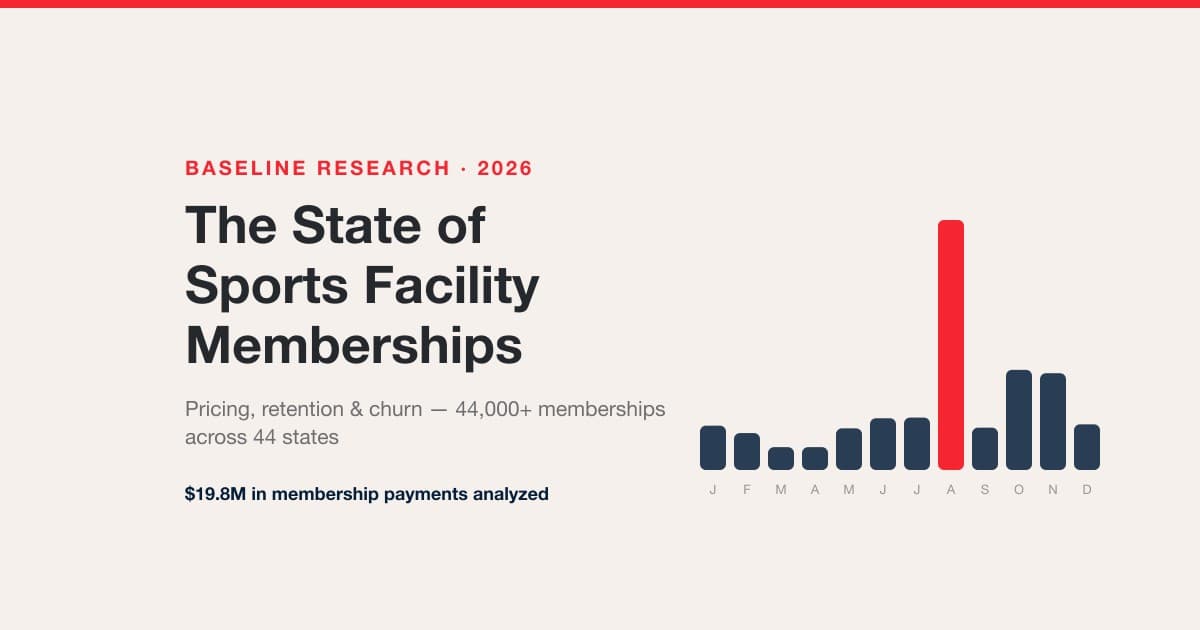
The State of Sports Facility Memberships: Pricing, Retention & Churn Across 44,000+ Memberships
We analyzed 44,000+ memberships and $19.8M in membership payments across hundreds of sports facilities in 44 states. What facilities charge by state, which membership styles retain, why annual billing doubles lifetime value, and the churn playbook the data supports.
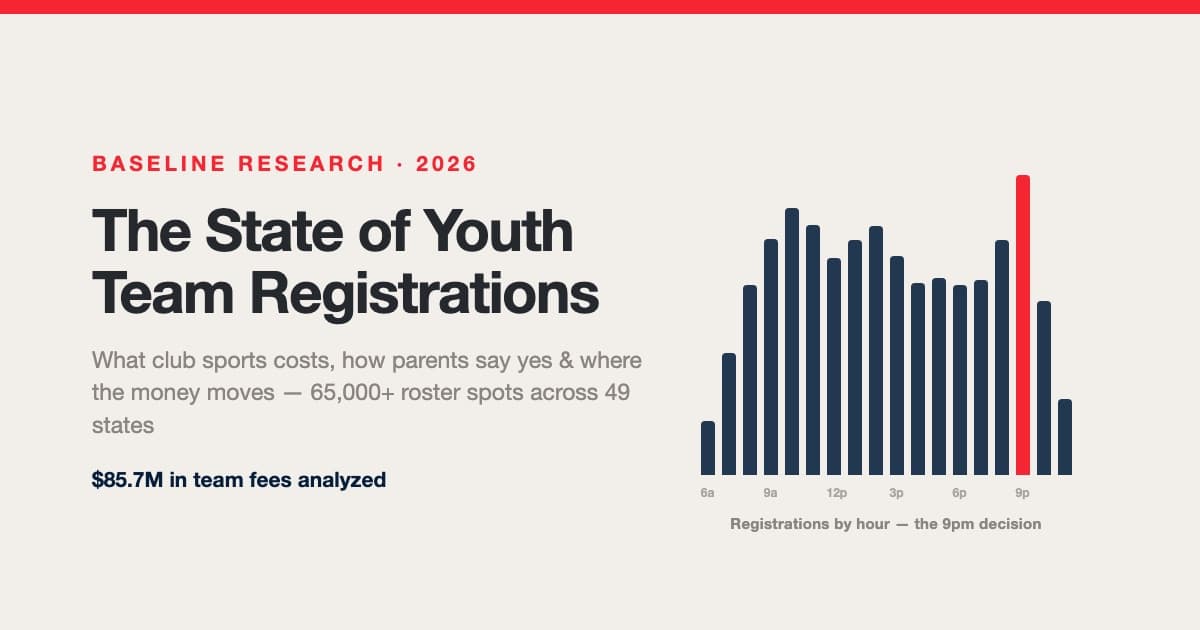
The State of Youth Team Registrations: What Club Sports Costs, How Parents Say Yes & Where the Money Moves
We analyzed 65,000+ roster spots and $85.7M in team fees across 337 club businesses in 49 states. What a season really costs by age and state, the $300 deposit standard, the ~15-point collection tax on cash-and-check dues, the 3x recollection gap between clubs — and the one screen where families pause on the way to a completed registration.
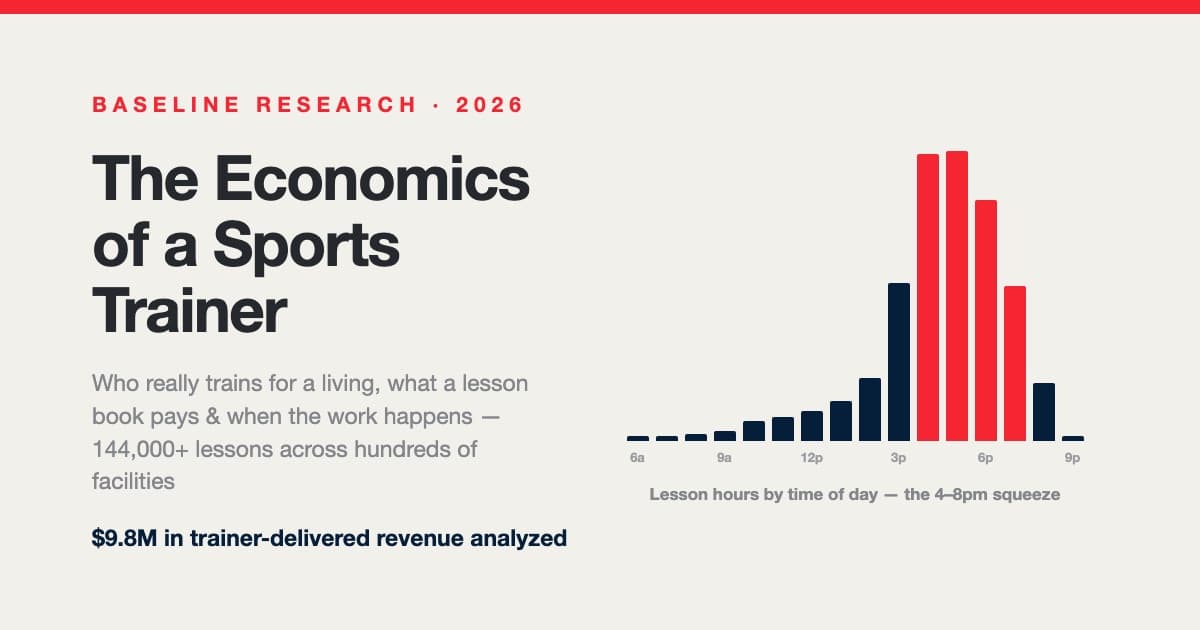
The Economics of a Sports Trainer: Who Trains for a Living, What a Lesson Book Pays, and Why the 4–8pm Wall Decides Everything
Inside a research cohort of training facilities: the full-time lesson trainer is nearly mythical (median 3.3 delivered hrs/week; 4.4% sustain 15+), the trainer split is a spectrum anchored at 50% and 60% that realizes near 47%, lessons run ~$104/hour in every discipline but strength, the median client book is 8 actives on a 90-day clock, and continuing books swing from −61% to +192% in a year — the numbers behind hiring, comp design, and the dependence ledger.