
The Two-Hour Registration Window: Urgency Without Attrition
One large youth baseball club was tired of chasing parents to finish registration, so we gave families a 120-minute countdown instead. 485 timed registrations later: completion held, the week-old follow-up list came in 45% shorter, and 95 of 98 second windows opened with the family already in the form. The full experiment log — including the claim we couldn't verify.
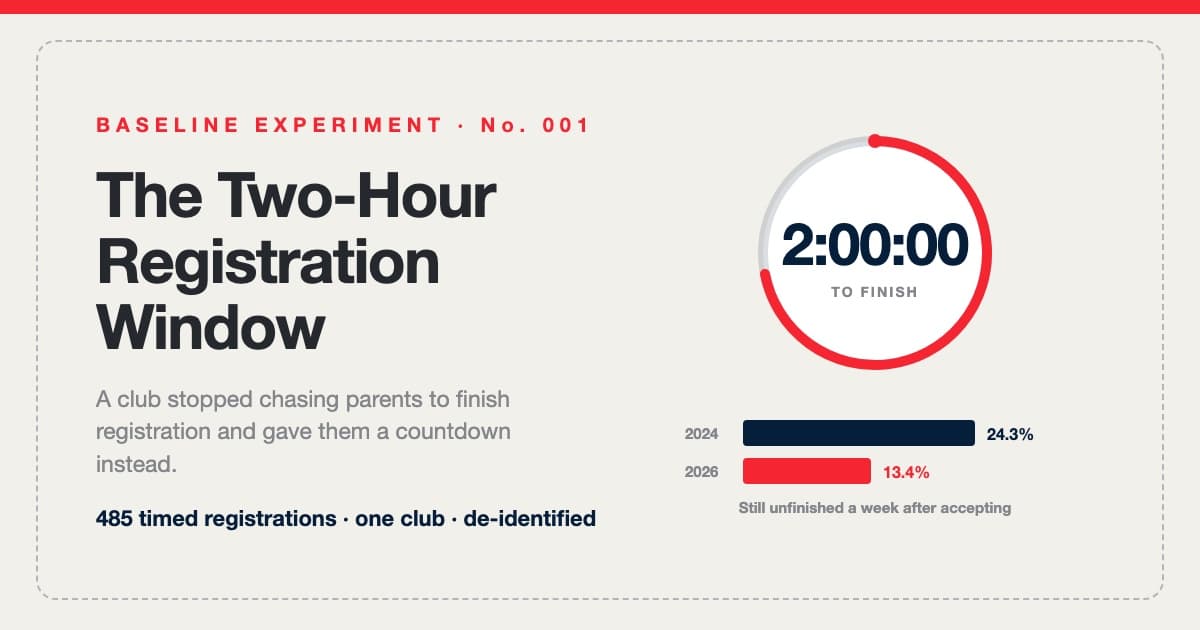
Big clubs spend their registration season chasing parents. Staff work a list, one text at a time, nudging families to finish a form they already started. One large youth baseball club wanted out of that job — and wanted the direction reversed, so that families came to the club asking for more time instead of the club going out after them. So this summer we put a countdown on team registration: finish within 120 minutes of opening the form, or the session closes. 485 timed registrations later, here is the honest ledger — completion held, the club's week-old follow-up list came in 45% shorter than its own history implies, and about one in five windows was restarted or extended, nearly always with the family sitting right there in the form.
- Problem being solved
- Staff were spending the season chasing parents to finish registration; the club wanted families reaching out to it instead
- Feature tested
- A 120-minute registration window — a visible deadline that starts when a family opens the team registration form
- Test site
- One large youth baseball club (de-identified), 68 teams registering for the fall season
- Window
- July 15, 2026 – August 24, 2026 · 485 timed registrations
- Compared against
- The same club's 2024 season (337 migrated registrations) and 7,617 concurrent untimed registrations across 136 other facilities
- Design
- Observational case study — descriptive, not causal. No random assignment.
- Primary question
- Can a deadline shrink the follow-up list and flip who starts the conversation — without costing the club completed registrations?
About Baseline Experiments
Why we built it
The request didn't come to us as “registration is too slow.” It came as a complaint about staff time. At a club running dozens of teams, someone has to own the outstanding list: pull the report, see who accepted a spot but never finished, and start working down the names. That work is unbounded — a family who hasn't finished today might finish next week, or might need three reminders, and there's no way to know which without asking. The club's ask was blunt: we don't want to chase people anymore. Make them come to us.
The data says that list is real and it is long-lived. Our registrations study found that a parent who opens a registration link finishes the whole flow in a median of about 20 minutes — but the families who don't finish in one sitting drift for days or weeks. At this club's own 2024 season, the median registration took 17 min, yet the 75th percentile took 4.3 days and the 90th percentile took 52 days. A week after accepting, 24.3% of that season's registrations were still unfinished — that is the list somebody had to work.
A deadline is an unusual answer to a staffing problem, and the logic is worth stating plainly: a countdown moves the burden of initiating from the club to the family. If your session expires and you still want the spot, you come back, or you ask for more time. The club stops maintaining a chase list and starts answering inbound. The risk, obviously, is that a deadline pushes families out of the flow entirely — urgency that costs registrations instead of saving labor. That is the trade this experiment set out to measure.
Ticket checkouts have worked this way for decades: hold the seat, show a countdown, and most people simply finish. The open question was whether the mechanic survives contact with youth sports registration, where the “checkout” is 16–21 questions, 2–3 contracts, a payment plan and a card — for a commitment that costs around $1,500 a season. Concert tickets don't ask you to upload an insurance waiver.
What we built
The registration window is a visible countdown attached to each family's registration session. When a family accepts a team invite and opens the form, the clock arms: they have 120 minutes to reach the finish line. If the window expires, the session closes — but the registration itself isn't destroyed. Coming back later starts a fresh window, and club staff can extend or reset a deadline for a family who asks.
Two design choices matter for reading the results. First, the deadline is deliberately soft: it pressures the session, not the family's spot — and in practice 59 registrations completed after their final recorded deadline had passed. Second, because returning starts a fresh window, our data records only each registration's final deadline. A final deadline far later than the first one is how we detect that a window was restarted or extended — we can't distinguish a staff reset from a family simply coming back on their own.
The setup
We compare three groups:
- Timed cohort. 485 registrations at the case club accepted between July 15, 2026 and August 24, 2026, where a registration deadline was recorded. (Another 60 accepted registrations in the window carry no recorded deadline — 20 of them accepted before the feature went live on day one — and we report them separately rather than quietly dropping them; every “all accepted” figure below includes them.)
- The club's own history. 337 migrated registrations from the equivalent July 15, 2024 – August 24, 2024 period — the last comparable season. The equivalent 2025 period contains exactly 1 registration (the club moved to Baseline after that season), so this is a two-year-old benchmark from the club's previous system, not a true year-over-year comparison.
- The rest of the platform. 7,617 self-serve registrations accepted during the same 2026 weeks across 136 facilities with no registration deadline of any kind.
For every group we measure the same things: whether a registration eventually completed, and how long it took from accepting the invite to finishing. Data snapshot: 2026-09-01. We wrote down five hypotheses first; here is how each one fared.
H1 — Did completion hold?
The timer will not materially change eventual completion, because the club already finishes nearly every registration it starts.
Completion rates only mean something next to their denominators, so here is the full grid rather than one flattering bar:
| Group | Of accepted | Of form-starters | Time to mature |
|---|---|---|---|
| Case club, started under a deadline (2026) | — | 99.2% (481/485) | 1–7 weeks, still counting |
| Case club, all accepted (2026) | 91.6% (499/545) | 93.8% (499/532) | 1–7 weeks, still counting |
| Same club, 2024 season (migrated) | 98.2% (331/337) | — | ~2 years |
| Untimed platform, same weeks (2026) | 90.1% (6,862/7,617) | 91.3% (6,862/7,519) | 1–7 weeks, still counting |
Read it honestly and three things stand out. The 99.2% headline is real but conditioned: a deadline is only recorded once a family opens the form, so that row can't be compared against groups counted from acceptance. The fair 2026 comparison is 91.6% vs the platform's 90.1% — a point and a half apart, both still rising as open registrations resolve. And the club's 98.2% from 2024 had two years to mature on its old system, and only registrations that made it into the migration at all — 7 of those 331 completions were even stamped by admins after the data moved over. High completion is what this club looks like on any system; the deadline didn't dent it, and we can't credit the deadline for it either.
H2 — Did registration get faster?
The window will compress the long tail — more families finishing within hours, far fewer drifting for days.
The shape of the curves is the finding. In the first half hour the club with a window is no faster than its 2024 self or the untimed platform — a deadline does not make quick families quicker. The separation is entirely in what happens after the first hours: by 24 hours the windowed club has completed 77.6% of accepted registrations vs 67.4% in 2024, and by three days 82.6% vs 71.8%. What the window kills is the drift — the registration that sits open for weeks.
| Group (completers) | Median | 75th pct | 90th pct | 95th pct |
|---|---|---|---|---|
| With window (2026) | 10 min | 71 min | 2.8 days | 7.1 days |
| … excluding instant-finish artifacts | 51 min | 19 hr | 4.9 days | — |
| Same club (2024) | 17 min | 4.3 days | 52 days | ~4 months |
| Untimed platform (2026) | 4 min | 1.7 hr | 4.8 days | 13 days |
The honest measurement caveat — read before quoting a median
What that did to the chase list
Those same completion curves, read from the other side, are the number the club actually cared about. Every accepted registration that hasn't finished is a name on somebody's follow-up list. So instead of asking how many families finished, ask how many were still outstanding — the list a staffer would have had to work.
A week after accepting, the club had 73 unfinished registrations to worry about out of 545. At its own 2024 rate that list would have held 132 names — roughly 45% larger. That is the closest thing in this study to a direct measure of the staff burden the club wanted gone, and it is the one number here we would point a skeptical operator at: not the speed, the size of the list.
Two honest qualifications. The 2024 comparison is the club's previous system, so some of that gap is a platform change rather than a deadline. And a shorter list is not the same as less outreach — a club can still text everyone on a short list. Whether total staff outreach actually fell is something our instrumentation cannot answer; we take that up in what this experiment can't tell you.
H3 — Did families need resets?
Restarts and extensions will matter — some registrations can't finish inside the first window and need a second chance.
Read the three branches together and the design rationale shows up in the data. 328 families finished inside a single two-hour window. 59 let their window die — typically opening the link, drifting away, and returning days after it had expired — and the soft deadline let every one of them finish anyway. And 98 carry a restarted or extended window: the slower, more complicated cases, whose median completion took 2.8 days — 95.9% of them still finished, and all 4 timed registrations still open at the snapshot sit in this branch, parked at the payment step. The urgency and the escape valves appear to work together: the deadline accelerates the middle of the distribution, and the resets and soft enforcement keep it from becoming a trapdoor for the rest.
The restarts are also where we can test the club's actual goal, and this is the part we did not expect to be able to check. If staff were quietly doing the old job — pulling the outstanding list and extending deadlines in batches — we would see it: dozens of registrations sharing an extension timestamp, granted while the families themselves were nowhere near the form. That is not what the data looks like. The 98 restarted windows carry 88 distinct deadline minutes spread across 29 days and 47 different teams, and 95 of them begin within fifteen minutes of that family answering a question, signing a contract, or entering a card. The second window opens when the family shows up. Whatever produced it — the clock re-arming on its own, or a parent asking someone for more time — the family started it.
What we can't observe is the counterfactual: how many of those 94 completions would have happened anyway with no timer at all. The club's 2024 data says most slow registrations did eventually finish — it just took weeks. And the ledger itself proves expiry doesn't equal loss: 59 registrations completed with their window long expired and no restart recorded. So the honest claim is not “resets saved 94 registrations” but “the deadline came with enough give that no one who kept trying was locked out.”
H4 — Where do families stall?
Required questions will be the most common unfinished stage — long questionnaires are where a two-hour window should bite.
This replicates the “money-screen wall” from our registrations study — families don't abandon because forms are long; they pause at the moment money gets real. A two-hour window doesn't change where registrations stall; it changes how long they stay stalled.
H5 — Was it the timer, or was it the club?
Much of the club's advantage over the platform benchmark reflects the club itself — its teams, families, and season — not the timer alone.
Three specifics keep us humble — and one cuts the other way. The club's families kept accepting invitations at 96.6% (vs 91.9% platform-wide), so there's no sign the deadline scared anyone off — but there's also no randomized control anywhere in this design: the club adopted the feature and ran its season its own way. Second, results vary by team even here: across the 48 teams with at least five timed registrations, the within-two-hours share ranges from 40% to 100%, and no team contributes more than 3% of the cohort — the result is broad, but it is one club's breadth. The counterpoint: the club's registrations are much heavier than the platform's — its completed registrations carry a median of 21 answered questions against 3 on the untimed platform — and it still finishes more of them within a day. Whatever mix of club culture and countdown produces that, it is doing it with a longer form.
What this experiment can — and can't — tell you
An experiment log should end with its own confidence, stated plainly. Here is ours, finding by finding — including two we marked down after the adversarial audit:
| Finding | Confidence |
|---|---|
| Registrations started under a deadline completed at 99.2% (481 of 485) | High · directly observed |
| The multi-week tail of slow registrations collapsed vs 2024 | Moderate |
| More of each week's registrations finish within 1–7 days than in 2024 | Moderate |
| The week-old follow-up list was ~45% shorter than the club's 2024 rate implies | Moderate · cross-system |
| Second windows open with the family present, not by staff batch action | High · directly observed |
| The typical (median) registration got faster | Low · fails instrument correction |
| About 20.2% of windows were restarted or extended | Low–moderate · inferred; a floor |
| Resets preserved registrations that would otherwise have been lost | Low · plausible, not observed |
| The timer increased eventual completion | Low · do not claim |
| The club beat the platform benchmark because of the timer | Low |
| Staff sent fewer messages — total outreach actually went down | Low · not instrumented |
That last row deserves more than a chip, because it is the club's own success criterion. We went looking for it and came back without it. The platform logs staff-composed messages and inbound texts, and on that record 54.2% of the club's registration-window messages were inbound — families writing in — against a median of 29% at the 28 comparable facilities we could measure. Encouraging, until you look at the other column: the club also sent more outbound messages per registration than the typical comparable facility (0.24 vs 0.15), so we cannot claim its outreach volume fell. And the log itself is too thin to lean on — it captures manual sends only, carries no message content, and can't be tied to a specific registration. The truthful summary is that the list got shorter and the resets were family-triggered, but whether anyone at the club actually stopped picking up the phone is not something this data knows. It is the first thing we would instrument before running this again.
The limits, spelled out: this is one club, one season, with no random assignment — season differences, team mix, reminders, staff behavior, and the migrated 2024 data all move these numbers in ways we cannot fully separate from the timer. 46 registrations were still open at the snapshot and may yet complete, so every 2026 completion rate is a floor. The recorded acceptance timestamp can re-stamp when a family returns, so durations are shown with and without the affected rows. The deadline field itself is a live system field, not a lab log: it stores only the final deadline, it was cleared on 3 abandoned registrations and re-stamped on others between our snapshots, and a few registrations were deleted outright by club admins — so the timed cohort's edges are softer than its four-digit precision suggests. None of these caveats reverses a direction; all of them shave margins.
The verdict
The verdict
Keep it — with the reset valve.
Turn it on if
- Your staff spends registration season working an outstanding list one name at a time
- Rosters need to close on a date, and stragglers are what keeps them open
- Your form is settled — questions, contracts, and plans a family can genuinely finish in one sitting
Hold off if
- Families routinely need mid-registration steps you can't do in a sitting — document hunts, physicals, reimbursement approvals
- Nobody is around to answer a family who writes in asking for more time
- You're expecting the timer to raise completion or speed up your fastest families — this experiment shows neither
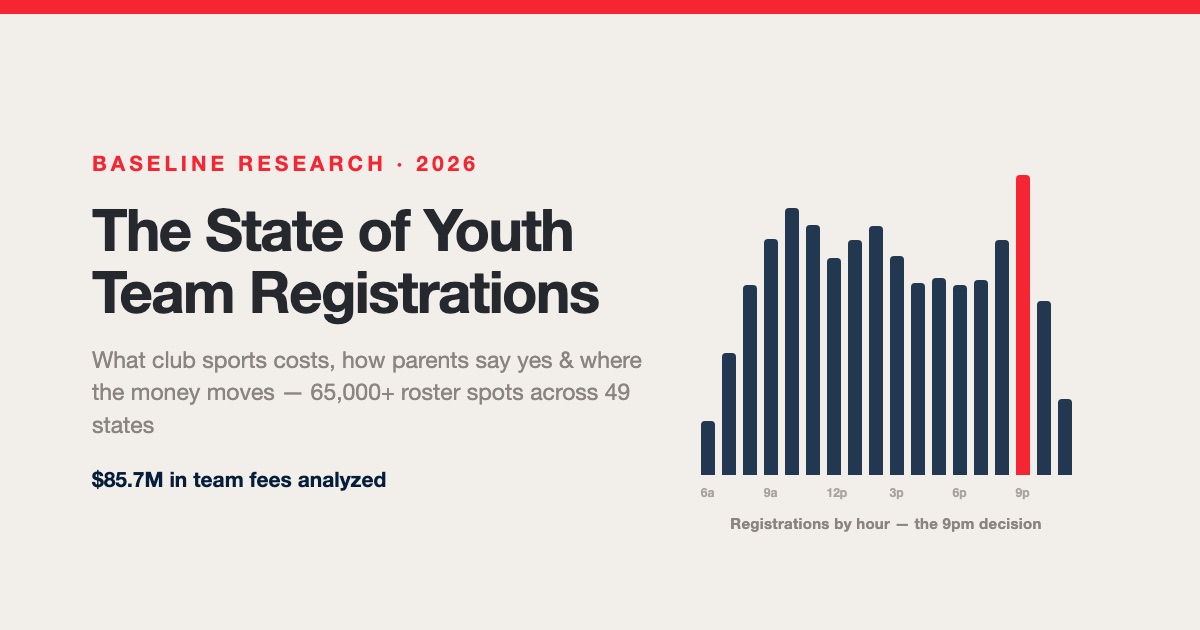
The State of Youth Team Registrations: What Club Sports Costs, How Parents Say Yes & Where the Money Moves
The platform-scale picture behind this experiment: 65,000+ roster spots, what registration really costs families, and where the funnel actually leaks.
Read the studyMethodology, definitions & fine print
- Design. De-identified observational case study of one club that adopted a 120-minute team-registration window. Descriptive only: nothing here estimates a causal effect of the timer. The five hypotheses were written before the data pull, and every headline number was re-derived independently by an adversarial audit before publication; the medians and one hypothesis framing were revised as a result.
- Timed cohort. Self-serve (link) registrations at the case club accepted July 15, 2026 – August 24, 2026, with a registration deadline recorded (485 of 545 accepted). The deadline arms when a family enters the form, so this cohort conditions on having started — which is why the fair comparisons in H1/H2 use all 545 accepted registrations. The deadline field is also mutable: it was cleared on 3 abandoned registrations across our July and September snapshots, so the 60 no-deadline rows may include a few former timed rows.
- Historical benchmark. The club's 337 migrated registrations accepted in the equivalent 2024 window, on its previous system. Migrated timestamps behave like organic ones (varied durations, a months-long tail), but migration is itself a filter — registrations abandoned in the old system may never have been migrated — and 7 of the 331 completions were stamped by admins after migration (excluding them, the 2024 rate reads 96.1%). The equivalent 2025 window contains 1 registration and is noted, not used.
- Platform benchmark. 7,617 link registrations accepted in the same 2026 weeks across 136 facilities with the feature off (facilities with any registration deadline were excluded). No single facility is more than 6.45% of the benchmark.
- Completion. A registration counts as completed when its completion timestamp is set and it was not declined. Times run from the recorded acceptance, which includes any delay before the form was opened — and which the system can re-stamp on a return visit, so duration figures are presented both raw and with the affected instant-finish rows excluded.
- Restart/extension inference. Final recorded deadline more than 130 minutes after acceptance; identical counts at 125/130/180-minute thresholds. Directly corroborated by earlier-session form activity in 83 of 98 cases. Because only the final deadline is stored, this undercounts total restarts and cannot attribute them to staff versus returning families.
- Follow-up list. Accepted registrations not yet finished at a given horizon — the complement of the completion curves, on the all-accepted base. It is a proxy for staff burden, not a record of outreach.
- Restart mechanism. A restart counts as family-present when the final window opens within 15 minutes of that registration's own recorded form activity. Batch admin extensions would instead show shared deadline timestamps; the 98 restarts carry 88 distinct deadline minutes across 29 days and 47 teams.
- Outreach direction. Measured against the platform's message log (8,425 events in the window), which records staff-composed sends and inbound texts only — no automated system mail, no message content, no link to a registration. Peer comparison covers the 28 untimed facilities with at least 30 accepted registrations and 20 logged messages. We report it as inconclusive rather than supporting.
- Anonymity. No club, team, family, or individual is identified; team-level figures are lettered and only reported for teams with at least five timed registrations. Message content was never read — only counts, direction, and timestamps.
- Limits. Single site, single season, account-level adoption, no randomization; 46 registrations still open at the snapshot; acceptance re-stamping inflates 2026 speed at the median (both versions shown); live-system field edits and a small number of admin-deleted rows soften cohort edges.
Questions about the data, or want a cut we didn't publish? Get in touch — we're happy to run custom aggregates for press and researchers.
Baseline is the all-in-one operating system for sports facilities, clubs, and travel teams — scheduling, payments, programming, and team management in one platform.
Keep reading
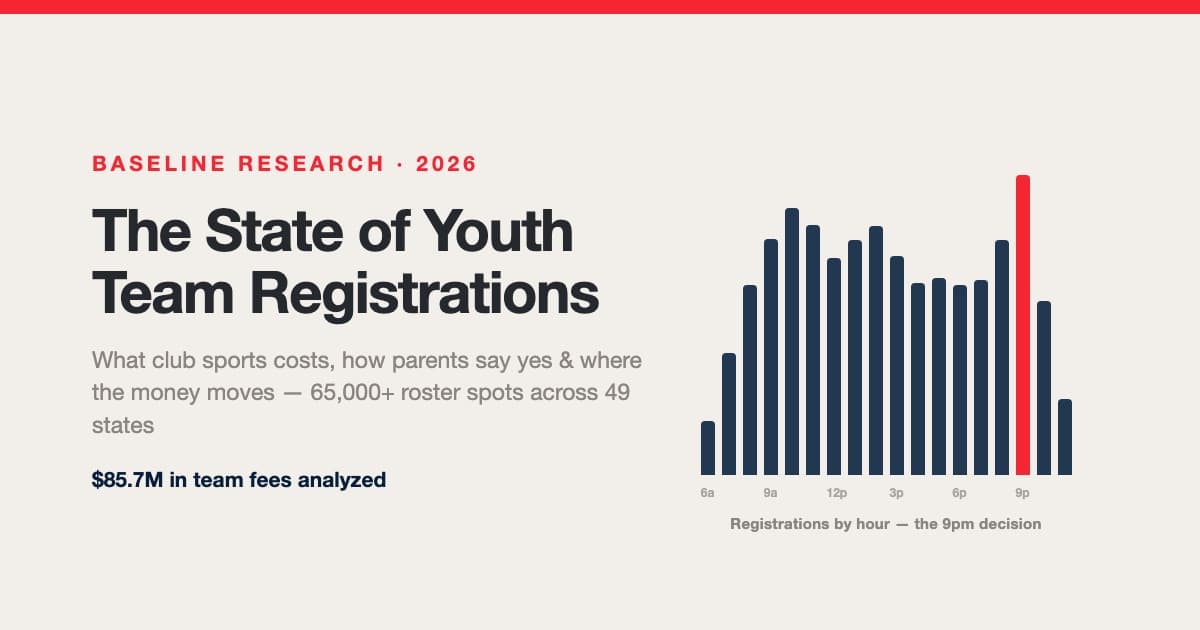
The State of Youth Team Registrations: What Club Sports Costs, How Parents Say Yes & Where the Money Moves
We analyzed 65,000+ roster spots and $85.7M in team fees across 337 club businesses in 49 states. What a season really costs by age and state, the $300 deposit standard, the ~15-point collection tax on cash-and-check dues, the 3x recollection gap between clubs — and the one screen where families pause on the way to a completed registration.
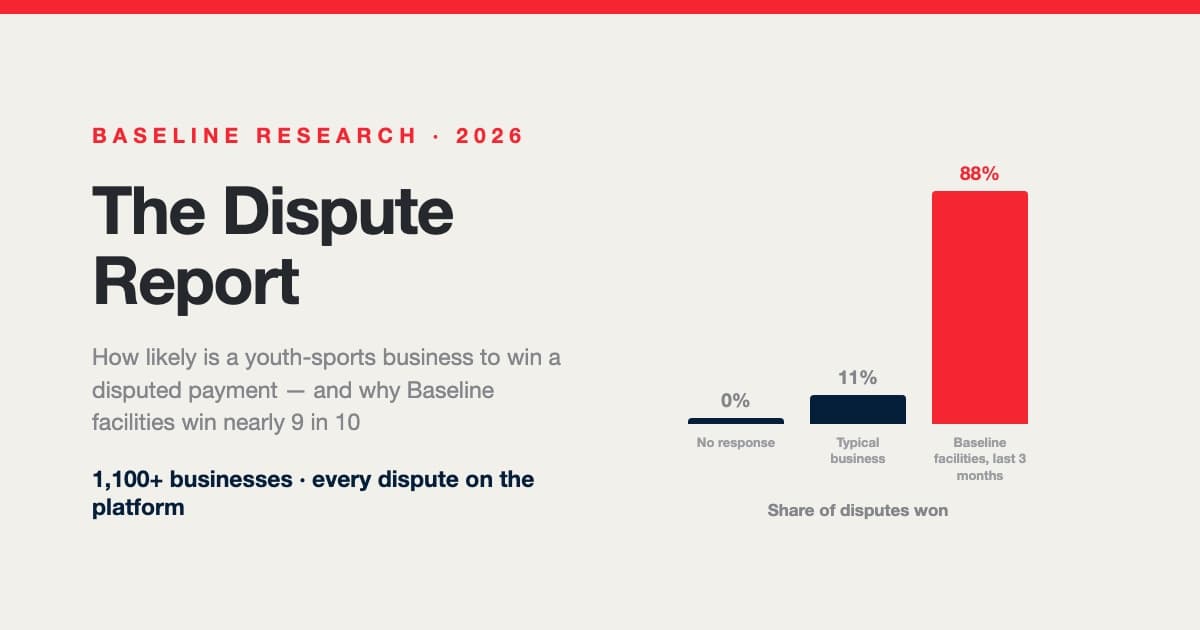
The Dispute Report: How Likely Is a Youth Sports Business to Win a Payment Dispute — and Why Baseline Facilities Win Nearly 9 in 10
Industry-wide, businesses answer barely half of their chargebacks and recover about 1 in 10. Across Baseline's platform of 1,100+ youth-sports businesses, 88% of closed disputes were won over the last three months — with 90% of responses filed without anyone touching a thing. How disputes actually work, what gets disputed at sports facilities (and which purchases win), why fraud codes are hardest, what each card network wants, and the pre-documented evidence system behind the numbers.
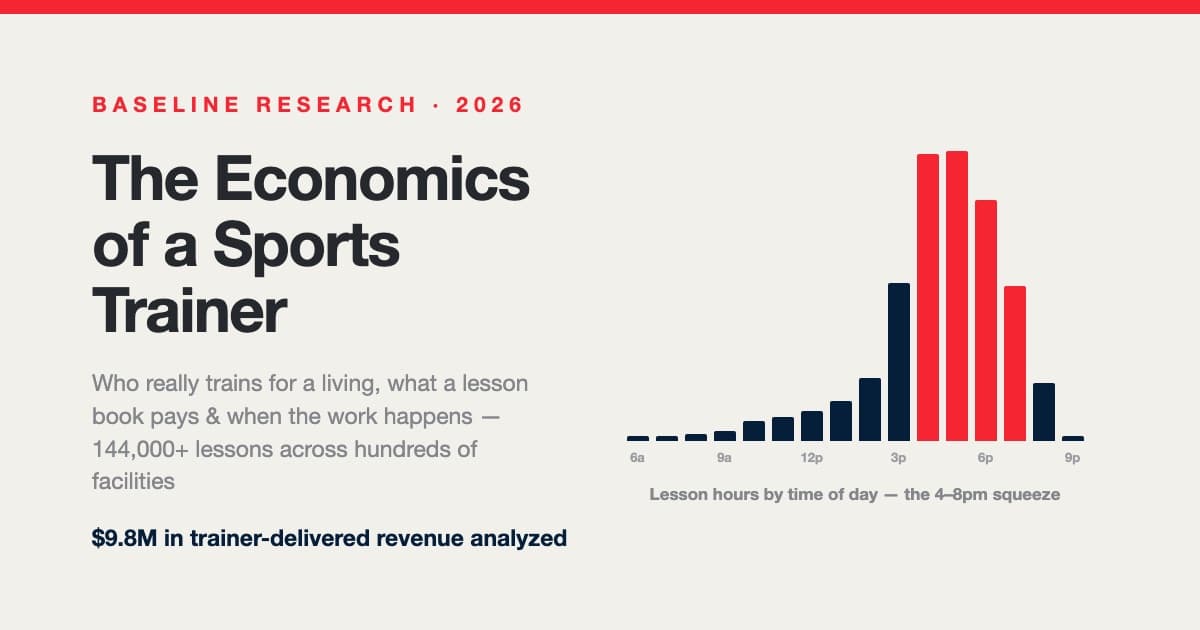
The Economics of a Sports Trainer: Who Trains for a Living, What a Lesson Book Pays, and Why the 4–8pm Wall Decides Everything
Inside a research cohort of training facilities: the full-time lesson trainer is nearly mythical (median 3.3 delivered hrs/week; 4.4% sustain 15+), the trainer split is a spectrum anchored at 50% and 60% that realizes near 47%, lessons run ~$104/hour in every discipline but strength, the median client book is 8 actives on a 90-day clock, and continuing books swing from −61% to +192% in a year — the numbers behind hiring, comp design, and the dependence ledger.