
The State of Sports Facility Memberships: Pricing, Retention & Churn Across 44,000+ Memberships
We analyzed 44,000+ memberships and $19.8M in membership payments across hundreds of sports facilities in 44 states. What facilities charge by state, which membership styles retain, why annual billing doubles lifetime value, and the churn playbook the data supports.
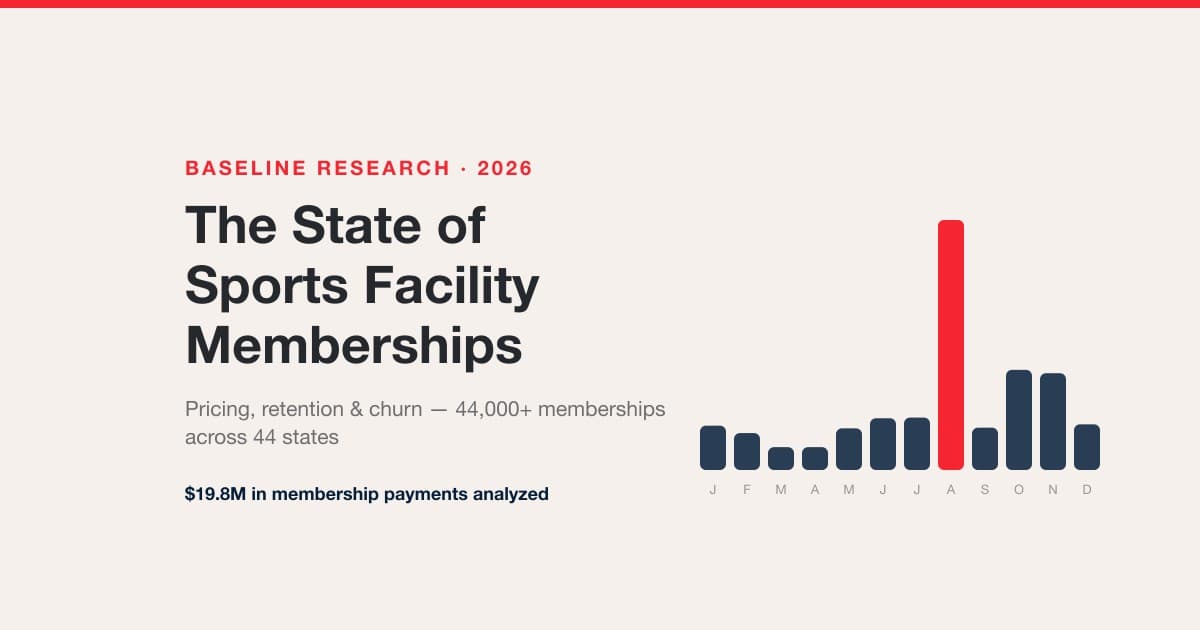
We analyzed 44,000+ memberships across hundreds of sports facility businesses in 44 states — $19.8M in membership payments — to answer the questions every operator asks: what should I charge, which membership styles actually retain, and what really causes churn. This is the most complete picture of sports facility memberships we know of. All of it is below, free.
About this study
Eight findings that should change how you run memberships
- Annual billing is the single highest-leverage retention tool we can measure. Members on annual cycles keep their membership at 82% after a year vs 35% for monthly payers — and deliver nearly 2x the paid months over two years.
- The first 90 days decide everything. Over half of all preventable cancellations happen in the first three months. Median tenure of a lost member: 87 days.
- Operators almost never raise prices. Same-facility median price change year over year is 0%. Three quarters of facilities didn't reprice at all.
- Contracts don't fix churn. Cancel-locked plans retain no better at 90 days — and worse at one year (31% vs 46%), because members quit at the cliff.
- August is a 3.7x signup month. Membership joins surge as school sports ramp up; March–April is the trough. Cancellations spike in July.
- Memberships smooth revenue dramatically. Same facilities see joins swing 10x through the year, but membership revenue swings only about ±18%.
- Pricing is regional, not national. The median Western facility charges $135/mo; the median Midwestern facility charges $80. State medians range from ~$41 to ~$249.
- Credit/prepaid-style plans churn fastest. Teams and seasonal programs retain best, then unlimited access, then dues-based recurring — credits and prepaid sessions lose a third of members in 90 days.
Part 1: What facilities actually charge
Across 1,681 active membership plans, pricing varies more by membership style than anything else. We classify every plan into four archetypes based on its configuration — dues-based recurring, unlimited access, credits/prepaid sessions, and team/seasonal programs.
Listed prices and what members actually pay are two different things. Weighting by real, active members, the median membership bills $100/month (mean $176) — meaningfully below the median listed recurring plan price of $180. Members concentrate in the lower tiers of every pricing ladder.
Operator takeaway
Membership pricing across the country
Pricing power is local. We computed each facility's median active-member price, then took the median across facilities in each state (states shown only where we have 5+ businesses).
The spread is wide enough that national averages are nearly useless for setting your price: a $130/mo all-access membership is a premium product in Georgia and a bargain in California. Benchmark against your region — or better, your metro — before you anchor a price ladder.
Prices are drifting up — but almost nobody repricing
The median new member paid $120/mo in 2024, $150/mo in 2025, and $150/mo so far in 2026 — a 25% step that comes almost entirely from mix: new facilities launching at higher price points and new premium plans, not from existing plans being repriced. When we hold the facility constant (same-store), the median year-over-year price change is 0% — and even the 75th-percentile facility moved prices just 5.4% from 2024→2025.
The repricing gap
Part 2: Billing cycles — the quiet retention lever
Monthly billing dominates: 72% of active memberships bill monthly, 22% annually, and the rest spread across 4-week, quarterly, semi-annual, and weekly cycles.
Here's why that chart matters. Annual members are massively stickier:
Self-selection is real — the member willing to prepay a year is already committed. But the size of the gap (and the churn model evidence below) says the cycle itself does work: annual billing removes eleven cancel decisions a year. Our churn model finds billing cycle is a top-3 churn driver in nearly every facility it fits, and that annual commitment is protective for usage, team, and seasonal plans alike.
Yet the option is barely offered: only 11.2% of active plans offer an alternate billing cycle at all. Where an annual alternative exists, 25.2% of members take it — at a median discount of just 8%.
Operator takeaway
The churn model referenced here — the one dissected in Part 7 — now ships inside Baseline. The Memberships report in Reports v3 scores every member's risk of leaving, separates expected churn from preventable churn, and lets you message an at-risk member without leaving the report.
Part 3: Pricing ladders — how facilities tier (and where members actually land)
Most facilities run more than one membership. Among businesses with recurring plans, the most common ladder has 2–3 tiers, but a large tail runs six or more.
The shape of a typical ladder: the top tier prices 2.69x the bottom tier (median), and each step up the ladder costs about +17% more than the tier below it.
Where do members land on those ladders?
That's a barbell, not a pyramid — the top tier outdraws the middle. Members either buy the cheap entry point or go all-in on the premium offer; the middle tier is the least-bought product on the ladder. If your mid tier isn't earning its slot, it's not a stepping stone — it's noise that makes the decision harder.
Operator takeaway
Part 4: How membership programs grow inside a facility business
For facilities that commit to memberships, the program compounds. Tracking each business from its first member:
The median facility holds ~12 active members one month in and ~40 by the end of year one — and the 75th percentile crosses 100. In dollars, the median facility's membership base bills $2,934/month (p75: $7,089; p90: $17,908) in recurring revenue.
And memberships are the fastest-growing line in the facility revenue mix: membership billing has climbed from under 13% of all facility revenue in 2023–2024 to 19% in 2026 year-to-date. 27% of facilities now count memberships as their single largest revenue category over the trailing twelve months, and at the top quartile of membership-committed facilities, memberships produce roughly half of all revenue. The median facility that sticks with a membership program takes it from ~4% of revenue at month 3 to ~15% by the end of year one:
Part 5: Seasonality — the operator's hardest problem
Every facility operator knows the feeling: the fall surge, the spring bleed. The data puts numbers on it. These indexes hold the set of facilities constant (same-store, 2024–2025) so platform growth doesn't distort the calendar pattern. 100 = an average month.
August joins run 3.7x an average month — school sports tryouts, fall ball, and indoor seasons all load at once — with a second wave in October–November as winter training starts. March and April are the trough at roughly a third of an average month. Cancellations peak hard in July (season endings + summer outdoor exodus) with a quieter, more dangerous bump in February–March: that one is mostly preventable churn, not scheduled program endings.
And here is the payoff for running memberships at all:
Joins swing 10x through the year. Membership revenue swings ±18%. That's the whole argument for recurring revenue, in two numbers.
Operator takeaways
- Pre-sell the July cliff. Your biggest cancel month is predictable. In May–June, offer summer-proof options: pause instead of cancel, a summer-only tier, or an annual renewal pitch before families scatter.
- Stack annual renewals into August–November. Sign fall joiners onto annual cycles and next year's renewal lands in your strongest season, not your weakest.
- Treat Feb–March churn as a save-able emergency. It's preventable churn (boredom, usage decay) — exactly what outreach, programming refreshes, and check-ins fix.
Part 6: Membership styles — what facilities sell, and what actually retains
What's inside the plans facilities sell today:
Now the part that matters — how each style holds onto members:
| Plan style | Still active @ 90 days | @ 1 year | Expected paid months (2-yr window) |
|---|---|---|---|
| Teams & seasonal programs | 95% | 87% | 19.9 |
| Unlimited access | 78% | 45% | 12.6 |
| Recurring dues | 78% | 42% | 11.9 |
| Credits & prepaid sessions | 67% | 32% | 9.6 |
Two stories here. First, program-attached memberships are in a different league — the member isn't buying access, they're on a team. The commitment is social, not transactional. Second, credits and prepaid-session plans churn fastest despite being the most common style on the platform: when the unit of value is "sessions remaining," every empty week is a visible reason to cancel.
The same plan performs differently depending on when the member joins
Fall joiners are the best cohort for dues-based recurring plans (83% 90-day retention vs 73% for winter joiners) and for credit plans (72% vs 62%) — they're settling in for a full indoor season. Unlimited-access plans flip: their best joiners arrive in summer, when open-gym time is the product. The January-resolution cohort is the weakest across the board.
Operator takeaway
Part 7: The churn deep dive
We classified all 21,819 recorded cancellations. The first surprise: 36% of "churn" isn't churn at all — it's seasonal programs and fixed-term memberships ending exactly when they were designed to end. Counting those as churn poisons every retention number a facility looks at.
Three things jump out:
- The biggest preventable bucket is the sports calendar — "season starting," "in season now," "playing travel ball." Facilities lose members to the very seasons they train them for, because nothing bridges the gap.
- "Too expensive" is nearly last. Just 0.6% of cancellations cite price. Members don't leave because of what it costs — they leave because they stopped using it. (Our churn model agrees: usage signals dwarf price within a facility.)
- A fifth of cancellations have no usable reason recorded. You can't fix what you don't measure — reason capture at cancel time is free churn intelligence.
The 90-day cliff
Retention isn't a program you run on month eleven. By the time most facilities notice a member fading in their sports facility management software, the median lost member is already gone. The save window is weeks 2–12: the member who hasn't built a habit yet, hasn't met a coach they trust, hasn't joined a group that expects them on Tuesday nights.
What a churn model trained on this data says
Baseline runs a churn-risk model for member facilities — a random-forest model fit per facility and plan segment on 16 behavioral and billing signals. Fit on each account's own history, it ranks a future churner above a future stayer 72–92% of the time. What it has learned generalizes:
- Engagement decay is the master signal. Days since last visit, visit cadence, and visit trend dominate. A member who hasn't walked in for 3+ weeks is the single most reliable churn precursor.
- Failed payments predict churn — resolved ones don't. A failed collection in the last 90 days is an alarm worth a human phone call, not just a retry.
- The same lever flips by plan style. On usage plans, higher spend predicts more churn (burnout); on team plans it predicts less. Annual billing protects everywhere except dues plans at the year boundary — calendar your renewal saves.
- Price is a weak in-facility signal. Within a facility, the expensive membership doesn't churn faster once usage is accounted for. Cheap-but-unused churns first.
The uncomfortable contract finding
35% of plans carry a cancel lock. Comparing members on locked vs unlocked recurring plans:
| Plan type | Still active @ 90 days | @ 1 year |
|---|---|---|
| Cancel-locked plans | 79% | 31% |
| No lock | 78% | 46% |
Locks don't even outperform in the lock window — and at a year, locked plans retain worse. The lock converts gradual disengagement into a hard exit at the cliff date, and the resentment usually walks out with them. (This is observational — locked plans differ in other ways too — but at minimum there is no evidence here that contracts retain.) Annual billing beats annual handcuffs: same commitment horizon, opposite member experience.
The churn playbook this data supports
- Instrument weeks 2–12. Onboarding sequence, first-month check-in call, a usage alert when a new member misses two weeks.
- Watch absence, not complaints. The member who goes quiet is the one leaving. Price objections are a rounding error.
- Bridge the sports season. In-season "maintenance" tiers, pause options, and team-season passes attack the #1 preventable reason directly.
- Call every failed payment. It's a churn alarm with a phone number attached.
- Require a cancel reason. One required dropdown turns a fifth of your churn from mystery into roadmap.
The operator playbook: ten moves, ranked by leverage
Everything above, compressed into a checklist worth taping to the office wall:
| # | Move | The number behind it |
|---|---|---|
| 1 | Offer annual billing at 8–10% off on your flagship plan | 82% vs 35% one-year retention; ~25% uptake when offered |
| 2 | Build a 90-day onboarding system — check-ins, habit hooks, usage alerts | 53% of preventable churn happens before day 90 |
| 3 | Attach memberships to programs (teams, clinics, training blocks) | Program plans: 87% one-year retention vs 32–45% for access plans |
| 4 | Raise prices 3–5% annually, communicated well | Median facility reprices 0%; new entrants anchor 25% higher |
| 5 | Pre-empt the July cliff with pause options and summer tiers in May | Cancels run 2x average in July |
| 6 | Sell hard in August–November, your 1.5–3.7x join window | August joins index at 372 vs 34 in March–April |
| 7 | Design the barbell ladder — strong entry tier, premium top, ruthless middle | Members split 52% / 22% / 27% across bottom / middle / top |
| 8 | Replace contracts with annual billing | Locked plans retain worse at 1 year (31% vs 46%) |
| 9 | Convert credit-plan members to recurring or program plans | Credit/prepaid plans lose 33% of members in 90 days — worst of any style |
| 10 | Capture a reason on every cancel | ~20% of cancellations currently have no usable reason |
Memberships are the closest thing this industry has to compound interest: the median facility builds to $2900+ in monthly recurring revenue within its first couple of years, top-quartile programs clear $7k/month, and the revenue holds within ±18% of average through a calendar that swings demand 10x. Every move above is about protecting that engine.
Baseline's membership tools automate most of this playbook — annual and alternate billing cycles, pause-instead-of-cancel flows, churn-risk scoring on every member, failed-payment recovery, and cancel-reason capture. See it live.
Methodology
Data. Aggregated, anonymized operational data from hundreds of sports facility businesses running on the Baseline platform across 44 U.S. states, covering 44,279 memberships, 3,748 membership plans, and 131,167 membership transactions ($19.8M gross) through June 2026. Obvious test accounts and businesses with fewer than 10 lifetime members were excluded.
- Anonymity. Every published figure aggregates at least 5 distinct businesses (k≥5); state-level numbers are medians of per-facility medians so no single business drives a value.
- Plan styles. Classified from plan configuration: credits/prepaid sessions, unlimited access, team/seasonal programs (explicit season dates, fixed durations, or team plans), and dues-based recurring for the remainder. Prices are normalized to monthly equivalents; implausible values are excluded.
- Retention. Kaplan–Meier survival from membership start, censored at the study cutoff. "Preventable churn" excludes by-design endings — fixed-duration plans and cancellations recorded as end-of-season/term completions — which are censored rather than counted as churn. Raw (uncensored) churn numbers would look roughly 10 points worse.
- Seasonality. Same-store indexes: only facilities live before each measured year contribute, and revenue seasonality averages each facility's within-year monthly share — so growth can't masquerade as seasonality.
- Limits. This is observational data from one platform's customer base, which skews toward training academies and youth sports businesses. Cuts like contracts-vs-no-contracts compare different businesses, not randomized groups. Where self-selection plausibly explains part of a gap (annual billing, contracts), we say so.
Questions about the data, or want a cut we didn't publish? Get in touch — we're happy to run custom aggregates for press and researchers.
Baseline is the all-in-one operating system for sports facilities, clubs, and travel teams — scheduling, payments, programming, and team management in one platform.
Take the full study with you
Download the complete research as a PDF to share with your team.
Keep reading
The Winter Season: How Indoor Facilities Schedule, Fill and Sell Their Busiest Four Months
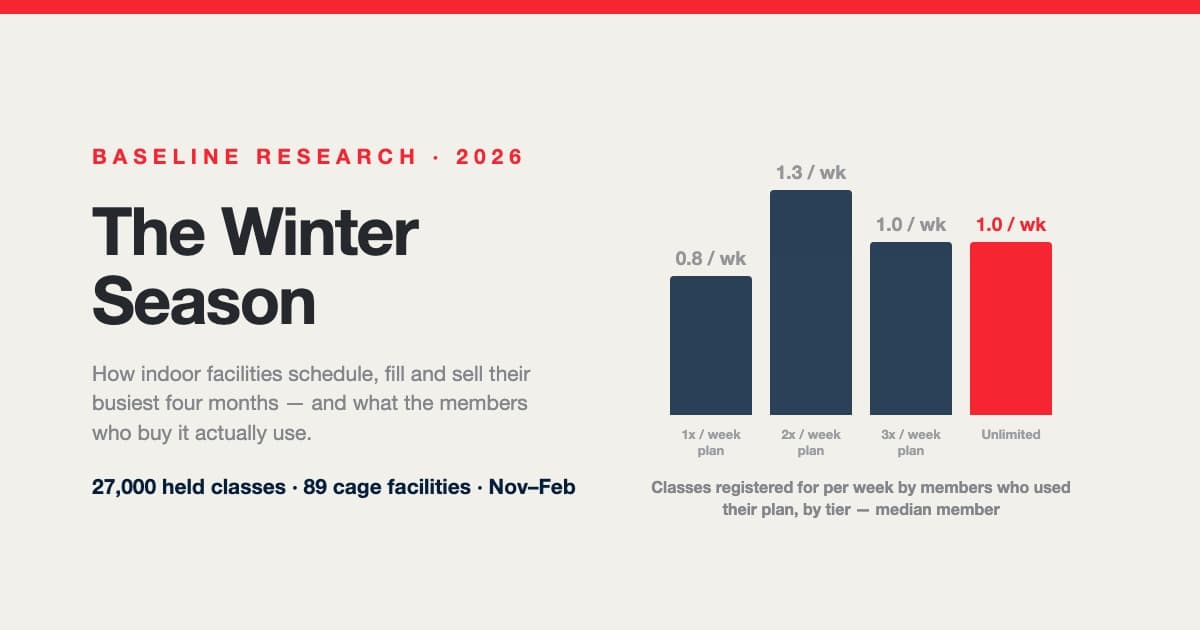
Winter is the season an indoor facility is built for, and every autumn operators rebuild the same schedule from instinct. Across 27,000 held classes at 89 cage-equipped facilities: pitching needs nearly as much room as hitting, the median class has three or four athletes, one hitting program in ten runs every prime hour, classes tie up two-thirds of the cages only at the busiest hour, “unlimited” members come about once a week — and the plan a family buys, not how often they come, decides when they leave.
The Dispute Report: How Likely Is a Youth Sports Business to Win a Payment Dispute — and Why Baseline Facilities Win Nearly 9 in 10
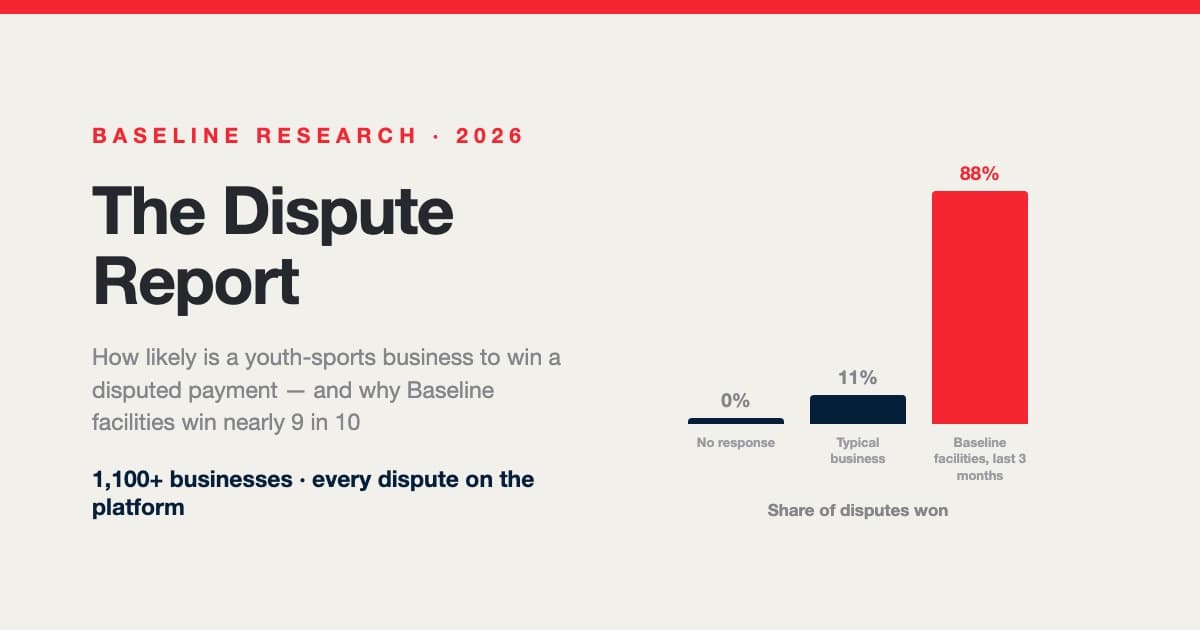
Industry-wide, businesses answer barely half of their chargebacks and recover about 1 in 10. Across Baseline's platform of 1,100+ youth-sports businesses, 88% of closed disputes were won over the last three months — with 90% of responses filed without anyone touching a thing. How disputes actually work, what gets disputed at sports facilities (and which purchases win), why fraud codes are hardest, what each card network wants, and the pre-documented evidence system behind the numbers.
The Economics of a Sports Trainer: Who Trains for a Living, What a Lesson Book Pays, and Why the 4–8pm Wall Decides Everything
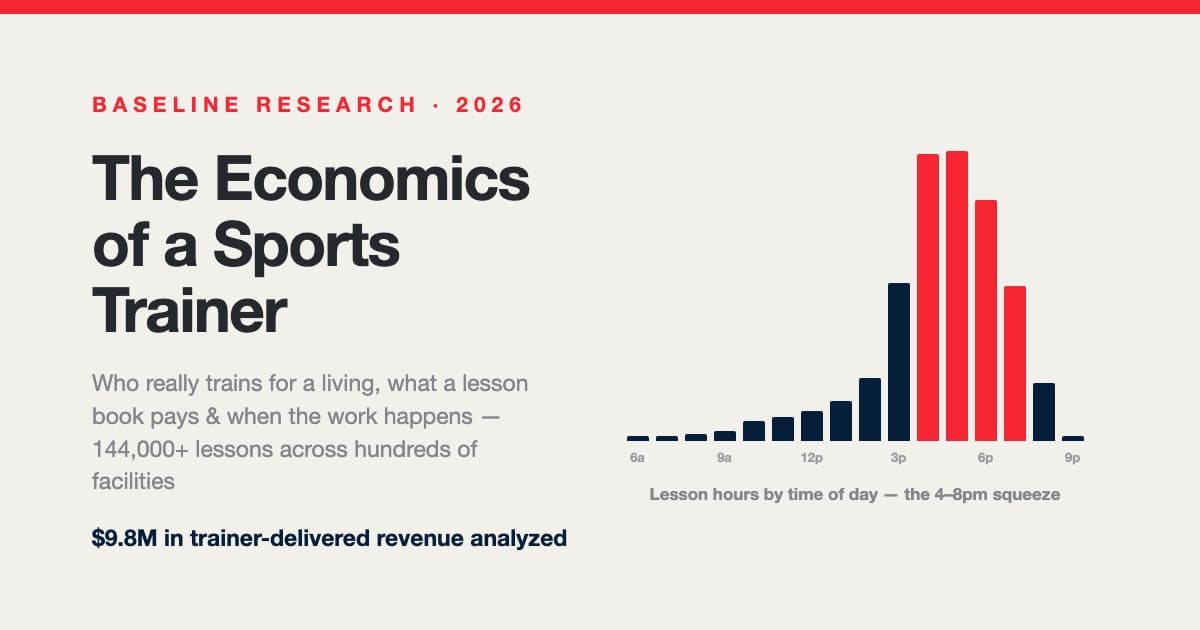
Inside a research cohort of training facilities: the full-time lesson trainer is nearly mythical (median 3.3 delivered hrs/week; 4.4% sustain 15+), the trainer split is a spectrum anchored at 50% and 60% that realizes near 47%, lessons run ~$104/hour in every discipline but strength, the median client book is 8 actives on a 90-day clock, and continuing books swing from −61% to +192% in a year — the numbers behind hiring, comp design, and the dependence ledger.