
Why Families Book Lessons — and Why They Don't: A Year Inside 268,000 Booking Sessions
A posted 5pm hour sells nearly three times as often as the same trainer's 11am. Across 268,000 booking sessions, 29,812 families and 107,000 posted trainer shifts, what decides whether a lesson happens isn't price, sport or lesson length — it's which hours are on the calendar and how late families go looking. Including a measured answer to the question every operator asks: do 15-minute intervals actually win you bookings?
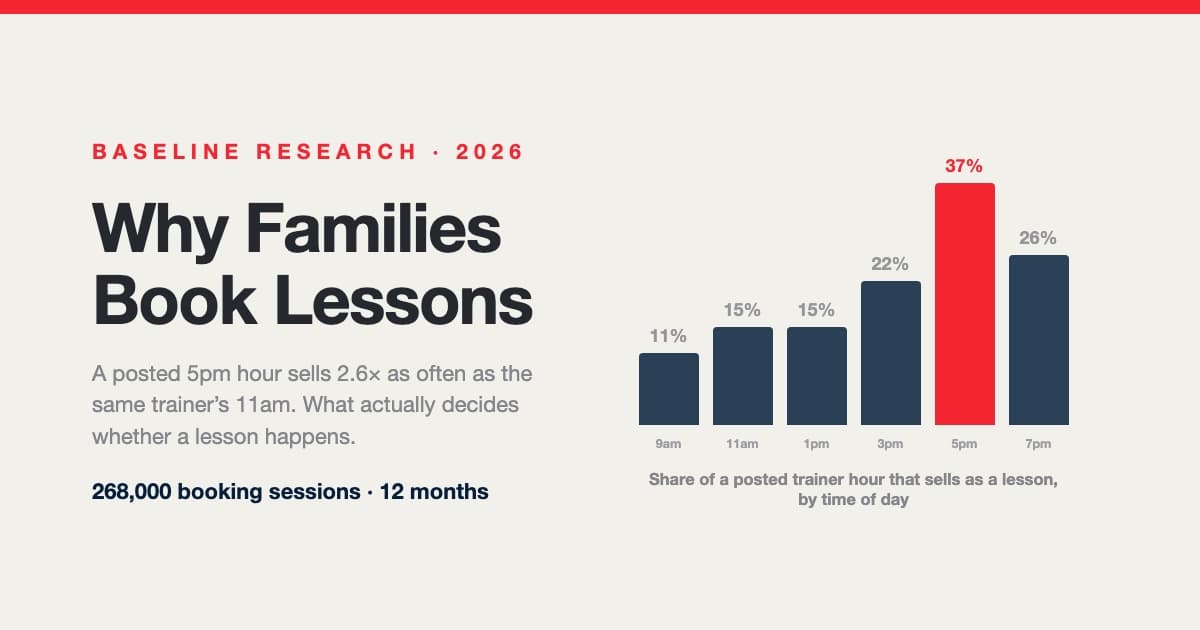
A parent decides their kid needs a hitting lesson. When it works, the whole thing takes 57 seconds — open the schedule, pick a time, pay, done. Most of the time it doesn’t work. We reconstructed 268,420 of those sittings across 285 youth-sports businesses over twelve months to answer one question: why do families book lessons, and why don’t they? The answer is not price, not sport, and not lesson length. It is almost entirely about time — when the family goes looking, and which hours the trainer put on the calendar. A posted hour at 5pm on a Tuesday sells 2.6× as often as the same trainer’s hour at 11am.
About this study — and what a “booking session” means
1. Not all hours are worth the same
Start with the single most useful number in this study. Take every hour a trainer posted as available, and ask what share of it actually sold as a lesson. Weekday 4–8pm sells 34.6% of posted time. Weekday 10am–2pm sells 10.5%. Same trainers, same facilities, same sport, same price — 3.3× the sell-through, purely as a function of where the hour sits on the clock.
The curve is the after-school wall, and it is unforgiving. Sell-through climbs from 14.6% at 11am to 37.4% at 5pm, then falls off a cliff after 7pm when families go to dinner. 63% of every lesson sold on the platform starts between 4pm and 8pm.
Here is the operational cost of that mismatch. Across the study, trainers posted 88,336 weekday midday hours and sold 9,272 of them — leaving 79,064 posted hours that no family was ever going to buy, because the athletes they belong to were in school. It is not a demand problem and it is not a pricing problem. Those hours were never sellable to a school-age client in the first place.
And this is not a handful of outlier facilities. Of the 131 businesses with enough volume in both windows to compare, 82.4% sell their after-school hours better than their midday hours — median 22.1% prime versus 9.1% midday.
The practical read
2. Families shop late, and for right now
The second half of the timing story is the family’s own clock. 72% of booking sessions (192,851 of 268,420) are shopping for a lesson inside the next seven days; only 12% are looking fifteen or more days out. Parents are not planning a season of instruction. They are solving this week’s problem — a slump before a tournament, a coach’s note about a swing, a suddenly free Thursday.
And the closer the lesson, the less likely it happens: same-day sessions book 20% of the time against 53% for sessions shopping two weeks out. The demand is concentrated exactly where the calendar has the least left to give.
The weekly rhythm is just as consistent. Monday is the busiest shopping day (21% of all sessions), falling steadily to a 9% low on Saturday. Sunday is the quiet winner: 15% of demand but the highest booking rate of any day at 40% — families planning the week ahead from the couch, with the calendar still open in front of them. Practically: next week’s hours need to be posted by Sunday morning, not Monday night.
3. “Is it because I don’t have 15-minute intervals?”
This one comes up constantly, so we measured it. On Baseline the slot grid runs in 30-minute steps by default; a facility that offers 45-minute lessons gets 15-minute starts (:00, :15, :30, :45) across every lesson length. So the two configurations exist side by side in the data, and we can just compare them.
| Slot grid | Businesses | Sessions | Booking rate (median business) |
|---|---|---|---|
| 15-minute starts | 79 | 64,750 | 33.5% |
| 30-minute starts | 243 | 203,237 | 33.6% |
There is no difference. The median business books 33.5% of its sessions on a 15-minute grid and 33.6% on a 30-minute grid. (Pooled across all sessions the 15-minute group looks 1.8 points better, but that gap is composition — a few high-volume businesses — and it disappears the moment you compare businesses to each other.)
That result makes sense once you look at what granularity actually does. Finer intervals give a family more ways to start inside an hour that is already open. They do not create a single new hour, and hours are what the previous two sections say families are competing for. If your 4pm is booked, a 4:15 start does not help anyone; the athlete is still at school at 11:15.
The setting that does move the number is how much notice you require before a lesson can start:
| Notice required before a lesson | Businesses | Booking rate (median business) |
|---|---|---|
| No notice required | 17 | 38.4% |
| 1–2 hours' notice | 74 | 36.5% |
| 3–12 hours | 146 | 31.9% |
| More than a day | 7 | 30.2% |
| 13–24 hours | 80 | 30.0% |
Businesses that let a family book with no lead time at all convert at 38.4%; businesses requiring most of a day convert at 30.0%. Every hour of notice you require is an hour of your scarcest inventory — tonight’s 5pm — that a parent shopping this afternoon literally cannot see. That is a bigger lever than any interval setting, and it costs nothing but a policy change.
4. The most common reason a lesson doesn’t happen
It is simpler than any of the above: there was nothing on the calendar. Of the 938 trainer-and-facility pairings that families actively tried to book in the final two months of the study, 36% had no bookable hours posted going forward at all — not fully booked, simply empty. Among trainers who do post ahead, the median publishes about 21 days out, the bottom quarter about 9 days, and 32% of all posted hours are entered after the fact, where no family could ever have booked them.
Depth pays, and it pays at every distance except today. Comparing families shopping the same number of days ahead, those looking at a trainer with two or more weeks of posted availability book 6–11 points more often than those looking at a trainer with less than three days:
5. What families do when they can’t find a time
Mostly, they flex — if you give them somewhere to flex to. After a session that ended without a time being picked, 53% of families who came back within the hour booked something different: a different trainer (22%), a different lesson type (27%) or a different length. The other 47% booked the lesson they came for, at another time or on another day.
Over a longer horizon 73% of sessions that hit friction are eventually followed by a booking from that same family. That number is reassuring and also misleading, because it is dominated by heavy bookers.
A power-booking family that can’t find a time today comes back 91% of the time; an occasional family comes back 9% of the time. Across the cohort, 38% of the families who ran into friction (7,905 of 20,697) never booked anything at all that year. An empty calendar doesn’t cost you your regulars. It costs you the family who was only ever going to try once.
6. When it works, it’s over in a minute
The flip side of all this friction is how little deliberation a successful booking involves. The median lesson goes from first click to completed payment in 57 seconds; nine in ten finish inside 4.2 minutes. Three behaviors are worth designing around:
- They buy in batches. 31% of completed bookings are followed by another booking session from the same family within thirty minutes — another date, another kid, another trainer. The moment after a successful booking is the highest-intent moment your schedule will ever see.
- They’re buying for someone else. 75% of completed bookings are made by someone other than the athlete taking the lesson. You are designing for a parent, usually on a phone, often booking for more than one child.
- Length and sport barely matter. 56% of sessions shop for a 30-minute lesson versus 37% for an hour, and the two book within three points of each other (38% and 35%). Across the eight most-booked categories, booking rates cluster between 34% and 38%. What a family is shopping for matters far less than when.
7. The spread between businesses is enormous
None of this is fixed. Among the 250 businesses with enough volume to rank, the booking rate at the 90th percentile is 2.5× the rate at the 10th — 48% versus 19%, around a median of 34%.
Two facilities with identical rosters, identical pricing and identical demand can sit thirty points apart. The difference is operational: which hours go on the calendar, how far ahead they go up, and how much notice stands between a parent and tonight.
8. What to do with this
- Staff the four hours that sell. Weekday 4–8pm sells 34.6% of posted time and midday sells 10.5%. If a trainer can only work twenty hours, none of them should be Tuesday at 11am unless you have a homeschool, college or adult book to fill them.
- Sell midday to a different customer, or stop posting it. The cohort left 79,064 posted midday hours unsold in a year. Those hours are real capacity for adult training, homeschool athletes, college kids home on break, or cage rentals — but they will not sell as school-age private lessons.
- Protect weekend mornings. They fill at 24.3% — the second-best window in the study — and they are the most under-supplied window on the platform.
- Cut your booking notice. Businesses requiring no notice book at 38.4% against 30.0% for those requiring most of a day. Long notice windows quietly delete tonight’s inventory from the calendar a parent is looking at right now.
- Post hours by Sunday morning, at least two weeks out. Sunday and Monday carry a third of weekly demand, and 36% of actively-shopped trainers had nothing posted at all. Depth is worth 6–11 points at every horizon beyond today.
- Don’t chase the interval setting. Fifteen-minute starts make no measurable difference to whether families book. They are a convenience for fitting lessons into an hour you already have — not a way to get more hours.
- Follow up with the one-time family. Power bookers come back on their own (91% do). The occasional family who found nothing this week mostly never returns — that is the group a text, a waitlist or one extra evening slot actually rescues.
Methodology, definitions & limits
- Data. Client self-service lesson booking on Baseline, September 2025 – August 2026 — 268,420 reconstructed booking sessions from 29,812 families across 285 businesses, 325 facilities and 1,570 trainers, joined to lesson transactions, 106,951 posted trainer shifts and 160,108 placed lessons. Aggregates only; no family, trainer or business is identifiable, and per-unit figures are published as percentile spreads.
- Booking session. Lesson-booking activity grouped by family, business and browsing session, split after 30 minutes of inactivity or a completed purchase followed by new activity. Sessions started within 24 hours of the data snapshot are excluded so every session has time to resolve. Alternative definitions (60-minute splits, 1-hour maturity, broader role filters) move every headline figure by less than 0.2 points.
- Fill rate. Lesson-hours booked ÷ trainer-hours posted, computed by walking every posted shift and every placed lesson into 15-minute buckets in the facility’s local time zone (DST-correct). Posted hours from different trainers add, since each is independently sellable. Two limits: posted hours may also be consumed by group sessions, team practices or other non-lesson work this study doesn’t observe, so fill is a floor on true utilization; and a trainer working at two facilities of the same business has their availability consumed by bookings at either, which this measure attributes to the facility where the shift was posted.
- Booking horizon is calendar days in the facility’s local time zone between the session and the lesson date being shopped. Sessions targeting past dates (1.5%) are excluded from horizon charts.
- Trainer runway is days of future posted availability the chosen trainer had at that facility at the moment of the session, from availability records and their creation timestamps. Deleted availability is not recoverable, so runway is an upper bound. The comparison is associational and is reported inside booking-horizon buckets to remove the mechanical confound.
- Configuration cohorts. Slot granularity, notice period and duration menus are read from each facility’s current configuration, so a business that changed settings mid-year is counted under its present one. These are cross-facility comparisons and carry every confound that implies; we report the median business in each group alongside the pooled rate precisely because the two disagree for slot granularity, and the per-business median is the more honest read.
- Cohort. Genuine client bookings only. Sessions created by facility staff, trainers or administrators are identified from each business’s own permission records and excluded — they are 21% of all lesson-booking activity and behave completely differently.
- “Booked.” The session produced at least one published lesson. 37% of sessions booked; 42% ended without a time ever being selected; the remaining 21% selected a valid time and did not complete. At the family level, 56% of families who opened a lesson calendar booked at least once during the year.
- What we can’t see. A calendar day with no posted hours is not clickable, so families who found a genuinely empty schedule leave no record — every rate here is measured on days that had some availability, which makes the availability effect a floor rather than a ceiling. We also cannot separate a family browsing idly from one who looked and found nothing workable; sessions that ended without a time selection are reported as exactly that, never as proven unavailability.
- Limits. One platform, youth sports, U.S.-skewed, heavily baseball and softball by mix. Booking rates below 30 sessions per business or trainer are suppressed entirely. Session volume grew substantially across the window as facilities adopted online lesson booking, so month-over-month movement reflects that mix shift and is not reported as a trend.
Questions about the data, or want a cut we didn’t publish? Get in touch — we’re happy to run custom aggregates for press and researchers.
Baseline is the all-in-one operating system for sports facilities, clubs, and travel teams — scheduling, payments, programming, and team management in one platform.
Keep reading
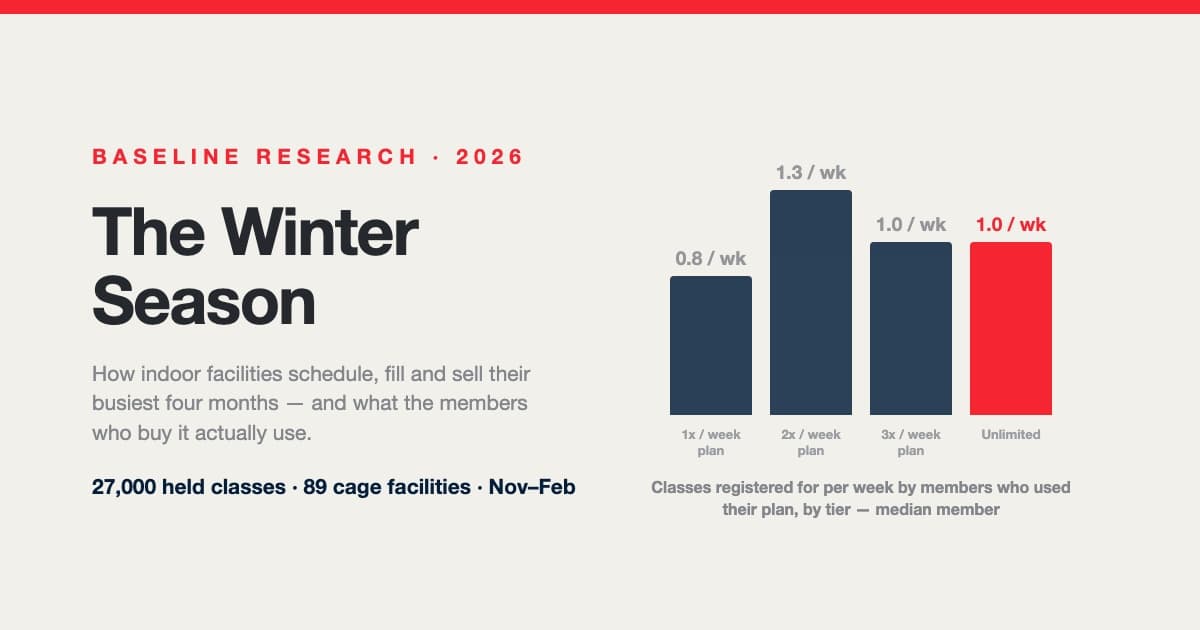
The Winter Season: How Indoor Facilities Schedule, Fill and Sell Their Busiest Four Months
Winter is the season an indoor facility is built for, and every autumn operators rebuild the same schedule from instinct. Across 27,000 held classes at 89 cage-equipped facilities: pitching needs nearly as much room as hitting, the median class has three or four athletes, one hitting program in ten runs every prime hour, classes tie up two-thirds of the cages only at the busiest hour, “unlimited” members come about once a week — and the plan a family buys, not how often they come, decides when they leave.
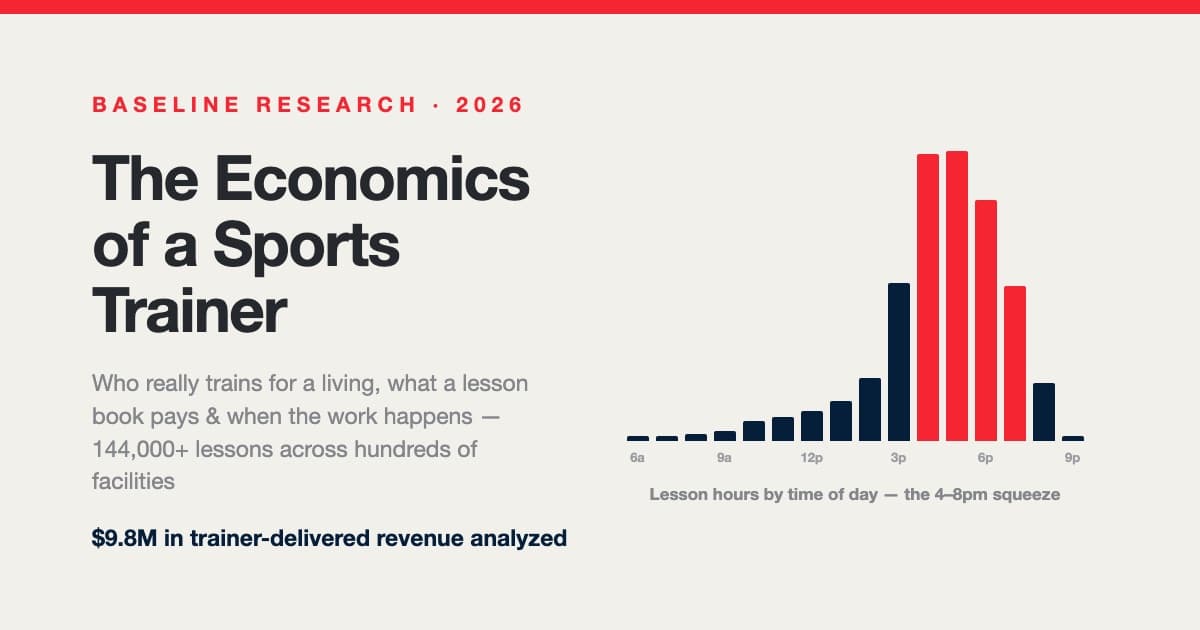
The Economics of a Sports Trainer: Who Trains for a Living, What a Lesson Book Pays, and Why the 4–8pm Wall Decides Everything
Inside a research cohort of training facilities: the full-time lesson trainer is nearly mythical (median 3.3 delivered hrs/week; 4.4% sustain 15+), the trainer split is a spectrum anchored at 50% and 60% that realizes near 47%, lessons run ~$104/hour in every discipline but strength, the median client book is 8 actives on a 90-day clock, and continuing books swing from −61% to +192% in a year — the numbers behind hiring, comp design, and the dependence ledger.
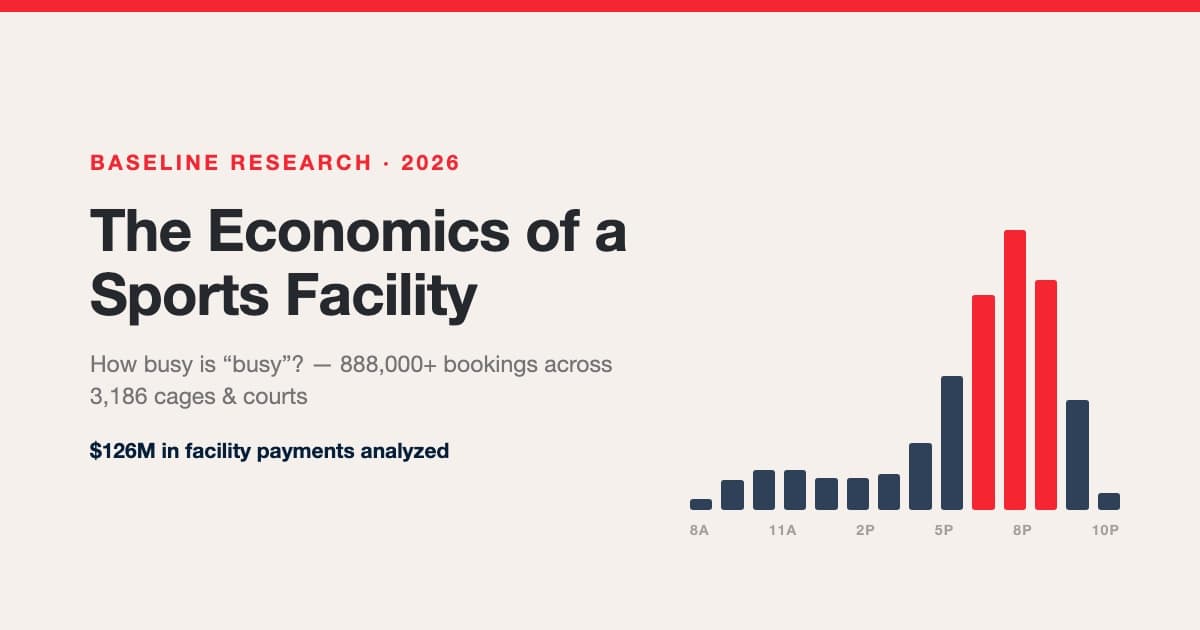
The Economics of a Sports Facility: How Busy Is Busy, What a Space-Hour Is Worth, and How the Packed Facilities Got That Way
We analyzed 888,000+ bookings, 863k space-hours, and $126M in payments across hundreds of sports facilities. Real utilization benchmarks (facilities are spiky, not empty — 2 in 3 sell out prime hours while averaging ~19% occupancy), rentals vs lessons vs group economics, the true lesson margin after trainer splits, credit-pack accounting, seasonality by category, and the occupancy ladder from quiet to packed.